Friday, 6 January 2012

Quick! Justify Our Existence!

Tim Worstall today highlighted a classic case of desperate scraping of the barrel in justification for illiberal measures.

In the same vein, here's another bang up-to-date example from Alcohol Research UK.

20% of men and 10% of women aged 65 and over exceed recommended drinking guidelines and 3% of men and 0.6% of women aged 65-74 are alcohol dependent.

Moderate drinking in later life has a beneficial effect on all-cause mortality and confers a number of psychological benefits, possibly through reduced stress and improved mood and sociability.
Isn't that great news?

However multiple biological, psychological and social changes that accompany the ageing process make older people uniquely vulnerable to alcohol problems. These vulnerabilities can include loneliness, diminished mobility, multiple bereavements, chronic pain, poor physical health and poor economic and social supports.
I see. So, because old people tend to suffer from ailments which affect old people, state-funded prodnoses should be employed to nag them on their alcohol consumption.

Brilliant!


Thursday, 5 January 2012

Great Ideas For The Future - Electronic Tagging For Kids

Welcome to this week's edition of Tomorrow's World, and to start off we report on an ingenious breakthrough for future public health screening ... electronic activity tags for kids.

In early 2012, wristwatch-like devices called Polar active monitors will be used by older students in PE classes at all 18 Parkway elementary schools. District officials say the devices should help improve the students' fitness and academic achievement.

Later this school year, the district plans to collect data about activity levels and even sleep patterns for a week at a time. It will have the students wear the devices round the clock.
All rather ingenious, so it is.

The monitors measure activity by tracking every movement of the person wearing them. They display steps taken, calories spent and time spent at various levels of activity. An animated figure on the monitor indicates the activity level. A bar shows the target time for doing moderate to vigorous activity and the amount of time achieved at that level.

Under the pilot program, the three schools each received 25 monitors, which cost $90 apiece. The monitors have been rotated among third-, fourth- and fifth-graders in physical education classes.

Each of the district's elementary schools will receive 25 monitors in January and begin using them in PE class.

However, the focus of the monitors' use will change gradually, so that by the end of the year students will continually wear the monitors for a full week at a time to assess activity levels.
Of course, like any innovation, there are always going to be teething troubles.

Neil Richards, a professor of law with Washington University in St. Louis who teaches privacy and civil liberties courses, said he feels the plan for the devices constitutes "a major privacy issue."

"The school district eventually will be engaging in surveillance of kids' sleep and exercise patterns outside the school day," he said. "Though physical activity is important and obesity is a problem, the district could not require kids to wear them because I think it would be a violation of their and their families' Fourth Amendment rights, which is pretty easily unconstitutional."
Bah! They're only primary school kids, for God's sake. Get with the program, Grandad. Anyway, such worries are being addressed as we speak.

Ramspott said the district plans to share all physical activity and sleep reports with parents [...]
See? The benevolent state is nothing if not generous. Plus ...

Ramspott said Parkway will require parental consent to participate ...
But, of course.

... largely because of the responsibility of caring for the monitors.
Hey, at $90 a pop it's expensive kit!

Still, parents should be asking what data is being collected from those devices and when, Richards said. They should ask what rights they have to control the data, whether data is anonymous, what safeguards will be in place to protect data, whether the district is going to give it or sell it to anyone, when data will be destroyed, and whether the district has a privacy policy available to parents.

"If a university would do this study, they'd need to have lots of approval and consent from our internal review board, because this is a form of human subject research," Richards said. "Though the district should be applauded for ensuring kids are healthy, this kind of biological surveillance seems to go far beyond what they should be concerned with."
For crying out loud! What is it with this guy? Does he not realise that it's essential for the state to concern itself with how children are raised - parents, less so?

He wonders what's next.

"Will they start monitoring kids' nutrition at home or how many hours they spend reading at home?" Richards asked.
Oooh, what a fantastic idea! We'll pitch it to the Department for Education next week.


Wednesday, 4 January 2012

Man Speaks Common Sense, Gets Slated

It's not often I excitedly applaud an article at the BBC, but this is one such piece.

[...] it offends my sensibilities as a professional social researcher, but it also offends me as a parent. With my wife, I have raised three boys in south London, and I think it is disgraceful that such a range of people - organisations, politicians and journalists - use terrible evidence, or in many cases no evidence at all, to perpetuate negative myths about the state of childhood and family life in the UK today.

I am also dismayed by how readily we as a society choose to believe them.
Oh this is so true. How, for God's sake, can anyone truly believe that kids are having a terrible existence in the modern world when, in the modern world, adults are increasingly having to engineer their lives around kids?

For example all the best evidence shows that parents now devote more time to caring for their children than ever before, and in particular the current generation of fathers has massively increased the amount of time they spend with their children compared to previous generations.
Demonstrably so. The experience of anyone who has kids will tell you that modern parenting is now almost a competitive sport. Mums and Dads of the late 20th and early 21st century are replaying the 'keeping up with the Joneses' battles of earlier times by trying to show how much more perfect they are than parents of their offspring's friends.

It's a pan-national race to the top, with kids being the undeniable winners.

Nor I would argue are our kids passive victims ripe for commercial organisations. They are actually rather savvy, and I think understand very well what commercial organisations are trying to do when they communicate with them, particularly when it comes to engagement online.
Hmm, I wonder which clowns are promoting such concepts, eh? Vested interests who are looking only to their next pay cheque, perchance?

So why is such a misleading picture being painted? Well first of all I think I have to point the finger at my profession. Quite a lot of bad social research is done, and people draw conclusions from their research that really it is not fair to draw.
You're preaching to the choir there, sunshine.

Another contributory factor is that the media love a bad news story, and reject good news ones. And of course the plethora of children's charities, competing for headlines and donations, understand this.
He's not ... he's not going to say the unsayable? Is he?

Those headlines, for example, were reporting views and research from the likes of Save the Children, the Children's Society and Barnardo's. These charities ratchet up the emotional ante, and I think as they do so their voices become ever more shrill, and reason disappears from the argument.
Yes, he is! Hallelujah!

A man after my own heart as I believe we've covered that kinda thing here before.

Academics feel the same pressure - to accentuate the negative. Their next research grant may depend on getting media coverage for their research, which is greater if the story is negative.

So there are real vested interests driving this.
At this point, I had to pinch myself to believe I was still reading the BBC.

My own children have all lost friends from their homes in south London when the parents, wanting to do the right thing, take them away from the city amid fears of violence and knife crime.

They take them to the countryside, where of course all the statistics show that they are far more likely to be run over in a rural road traffic accident than they ever were to be a victim of knife crime in south London.
The same risk-petrified mindset which encourages paedohysteria like this, in fact.

So the next time you read or hear about social decline, simply ask yourself what evidence do they have, and then ask whether it is really getting worse.

You may find that things are much better than you thought.
And wild applause as he nails the dismount.

So how was this received by the great British BBC reading public? Well, with derision and denial, of course. Commenter after commenter queued up to advance the ideas they have had implanted by decades of drip drip media and vested interest misinformation.

Just as readers here will all have been ridiculed for, at some point, explaining facts to their friends and colleagues such as alcohol consumption has been declining for years, or that obesity isn't really any kind of problem if one looks at the figures instead of the Daily Mail.

Because we are living in an age where myth has been installed as fact, and many incontrovertible truths are dismissed by a majority who trust people who simply don't deserve it. 'Jamie Oliver said it, so it must be true' syndrome.

The Heresiarch pointed to just such an example between Christmas and New Year.

"Britain’s problem with alcohol is not due to price, but a culture of excessive consumption," says the Telegraph. Actually, excessive consumption isn't the problem (by European standards, it is not excessive). Culture, though, is. What causes the Hogarthian scenes that disfigure town centres of a Friday or Saturday evening? Not alcohol, but rather a set of cultural beliefs about alcohol that produces (prompts, encourages, excuses) loutish behaviour. Read Kate Fox's Watching the English if you don't believe me. She discusses psychological experiments that show people will get drunk on placebos while staying sober on alcohol that they believe to be water, and notes that "many other nations manage to consume much larger quantities of alcohol without becoming rude, violent and generally disgusting." She writes:

These basic facts are, among my fellow cross-cultural researchers, so obvious and commonplace as to be tedious. We are certainly all very weary of repeating them, endlessly, to audiences who either cannot or will not accept their validity. Much of my professional life has been spend on alcohol-related research and my colleagues and I have been trotting out the same irrefutable evidence for over a decade, every time our expertise is called upon by government departments, police conferences, worried brewers and other concerned agencies.

Everyone is always highly surprised... and politely determined to let nothing shake their faith in the evil powers of the demon drink. It's like trying to explain the causes of rain to some remote mud-hut tribe in thrall to the magic of witch-doctors and rain-makers.
For 'mud-hut tribe', substitute Westminster, and for 'audiences who cannot and will not accept validity', how about your friends, acquaintances, and neighbours who are so easily hoodwinked by professional liars?

A well-respected 'expert', pictured yesterday

It's not like they're even making life easier or more enjoyable either. I suppose yer average bread and circuses engrossed human just feels comfortable being shat on.

Such a shame that so many are happy to abrogate their time on this Earth to self-serving people who care nothing for them, and never will.


Tuesday, 3 January 2012

Myth-Busting For The Masses

Oh dear, word is starting to get out that those advisory alcohol units - which public health like to portray as rigid limits - are a bit crap. Once the most venerable Stephen 'national institution' Fry pronounces against them, you just know that alco-worriers are on dodgy ground.


Delightful.

H/T The Skinner


Monday, 2 January 2012

The Irresistible Rise Of The E-Cig: Bad News For Tobacco Control

The subject of electronic cigarettes is fast becoming one of the most interesting public health battlegrounds of 2012 and, gloriously, it looks like it could also be a very embarrassing one for anti-smokers.

We're very used to 'swarm politics' from the tobacco control industry, whereby they all spout off on the latest proposed prohibition when one of their coalition blows an embargoed whistle, but press coverage of e-cigs in the past few days has been relentless without any noticeable co-ordination.

For a start, the fiercely anti-smoking Independent have come out firmly in favour of them. Their Chief sports writer, James Lawton, penned a puff piece on New Year's Eve while on the same day, even tobacco company involvement didn't deter the paper from publishing more extremely positive column inches.

Companies, including some of the biggest names in tobacco, are poised to launch a generation of devices that mimic the experience of smoking without the lethal effects.

One, being developed by a 29-year-old Oxford graduate, has attracted the attention of BAT, one of the world's largest tobacco companies, which has bought the rights to market it. A profusion of electronic and other devices has appeared in the past year, thanks to a legal loophole which allows them to be sold freely so long as they do not make any health claim.
Can you just imagine the horror of the psychotic wing of anti-smoking when they read such heresy in one of their favourite left-leaning rags? For the most committed tobacco-hating bigots, e-cigs are just a means by which many smokers are able to escape hideous, holier-than-thou, evangelical bullying, so I'm sure the bug eyes of one renowned weapons grade arsehole would have burned like being injected with acid if he opened the page and was hit with that.
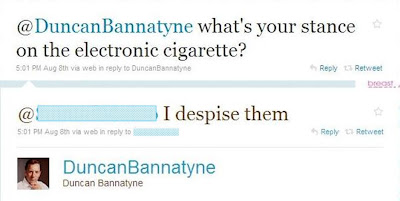
He wouldn't be alone, either. As I've said before, e-cigs confuse (and scare) the hell out of anti-smokers, so much so that they have been charging around trying to ban them everywhere they possibly can. I wrote the other day about Holland's sad capitulation, but they're also currently illegal in supposedly free societies such as Australia, Brazil, Finland, Singapore and Canada.

Of course, if scathing articles like this today from one of Canada's largest news sources become more frequent, that may change.

It’s clear that since nothing is being combusted in an e-cigarette, their use is significantly less harmful than smoking. A 2010 paper published in the Journal of Public Health Policy reviewed the available data and concluded that, “electronic cigarettes are a much safer alternative to tobacco cigarettes.” Researchers at the Canadian organization TobaccoHarmReduction.org called e-cigarettes “the tobacco harm reduction phenomenon of the year.”

But just because a technology has the potential to save millions of lives, doesn’t mean someone hasn’t tried to ban it.

To figure out why the government would try to prohibit the use of these products, one simply has to follow the money. Between 2001 and 2008, the federal government collected $20.4-billion worth of tobacco taxes. Rather than implementing policies that are in the best interests of Canadians, it is the government that has become addicted to the lucrative tobacco industry.

It’s time to break the addiction: End the Canadian ban on electronic cigarettes.
Amen. Although the author solely places the blame on politicians, rather than equally the mentally unbalanced smoke-haters and richly-funded - partly from tobacco taxes - professional tobacco prohibitionists who advise them.

Because that's the way the pharma-backed "quit or die" approach is intended to work. You quit by approved crony capitalist means, or the state and its allies will be quite happy to see you die.

It really hasn't ever been about health, and e-cigs are a perfect example. Especially since we've seen it all before, as the last of those recent articles I mentioned points out.

Writing for Ad Age - again, today - Judann Pollack recalls a time in the 80s when the battle for nicotine profits was won by smoke haters, and when - by tobacco control's very own reasoning - thousands of people died prematurely as a result.

According to the Centers for Disease Control and Prevention, there have been more than 10 million smoking-related deaths since 1988. I often wonder whether that figure would be lower if it weren't for the rigidity of the anti-smoking lobby.

Our story this week about marketers being unable to tout the potential health benefits of electronic cigarettes brought to mind an Ad Age storyline from 1988: The rise and fall of Premier. Premier was an audacious attempt by R.J. Reynolds Tobacco Co. to sell a cigarette that heated, rather than burned, tobacco. It created no sidestream smoke, produced no ashes, contained zero tar, and had 97% less nicotine and 70% less carbon monoxide than other brands at the time.

Yet health advocates rebelled, maintaining, as they do now, that there's no such thing as a safer cigarette.

So with the best intentions, anti-smoking groups swooped into the St. Louis and Phoenix test markets faster than you could say "cancer stick." Local health organizations petitioned the state Board of Pharmacy to label Premier a drug and remove it from market. It was denounced by health commissioners in Missouri. New Jersey held hearings to ban Premier, even though it couldn't be purchased within 1,000 miles of the Garden State's border.
Err, I'd argue with the 'best intentions' bit, unless talking about protecting salaries and research grants of course, but the rest is quite true and documented elsewhere.

Former tobacco control activist Michael Siegel regularly highlights instances where the movement have gone off the rails and actively encourage politicians to bring in legislation which is pathetically thought-out and arguably kills people, but e-cigs are the best example yet by a long chalk.

And it is a major one which is happening now while modern communications enable the proof of their disgusting (and lethal) rent-seeking methods to be spread widely.

They have tried their utmost, globally, to extinguish (pun unintended) e-cigs despite their being a demonstrable boon to those wishing to move away from smoking. All because tobacco control's favoured quit partners and sponsors - who, by an amazing coincidence, all happen to be competing pharmaceutical companies - have told them to.

That they haven't succeeded, and now look likely to have to admit abject defeat, is not down to anything else other than true 'grassroots' opposition, rather than the feigned state-funded one that the likes of ASH still try to portray themselves as.

Time for some trumpet-blowing, I think, as I did predict as much last March.

As user numbers swell, government's enforcers in Whitehall are going to find it increasingly difficult to cut off vapers from an alternative to tobacco which offers massive harm reduction potential, without showing themselves up as vested interest stooges (if they haven't already, natch).
To put it bluntly, any anti-smoking organisation who continues to act against e-cigs are openly admitting that they have no care for smokers' health (as if they ever did), and that can only be a good thing.

The sooner they are seen as the prohibitively costly, self-serving tax leeches that they are, feeding the prejudices of the most obnoxious in society, warping social fabrics worldwide, while delivering little by way of net health benefits, the better for all concerned.

The game's afoot for 2012, and I for one be watching developments with great interest.


He's Got A Point, You Know

John Redwood has kicked 2012 off with a cracker.

Public sector managers appear on the media to say they cannot do a good job because they are short of money. Private sector managers appear on the media to say they are doing a good job despite the shortage of cash.
Uncannily enough, the little Ps had been asking what public and private sectors mean just before Christmas. I'll file this in the memory for next time they show their curiosity.


Sunday, 1 January 2012

Public Health Snobbery

In a piece I've been meaning to highlight for a few days, Reason's A. Barton Hinkle has gone all uncharacteristically prohibitionist, so he has. And boy does he make a good point.

Isn’t it about time America banned soccer? Not because of British hooligans or the vuvuzela that has now made it into your local dollar store, although Heaven knows soccer has plenty to answer for on both those scores. No, the question at hand is whether soccer should be banned because of the other costs it imposes on society.

This comes up thanks to a little story from a few weeks back about a new study finding that “heading” a soccer ball can lead to traumatic brain injury.

Okay, so perhaps we don’t need to ban soccer outright. Perhaps we should only require players to wear helmets. But what about sports in general? In the aggregate, they cost society a tremendous lot of money.

According to the National Center for Sports Safety, more than 3.5 million children receive medical treatment for sports injuries every year. Sports and recreation account for a fifth of traumatic brain injuries among young people, which the CDC says have increased 60 percent in the past decade. Overall injury rates for various sports are surprisingly high: 28 percent of youth football players get hurt. So do a quarter of all youth baseball players, more than a fifth of all youth soccer players, and even 15 percent of all youth basketball players. Even gymnastics is responsible for tens of thousands of injuries a year.

Obviously, this imposes huge costs on society. Those injured players who are insured drive up premiums for everybody. Those who are not insured receive charity care, which drives up hospital rates. People who play sports are engaging in risky behavior that hurts us all, for their own selfish enjoyment. Somebody needs to put a stop to this.
Very reminiscent of Joe Jackson's Dog Ban proposal, isn't it? It should be, of course, as both articles sagely lampoon the same selective hypocrisy, as Hinkle succinctly points out.

If you think the preceding paragraph is a barrel of 180-proof rot, good for you. But this is precisely the sort of argument that is being made in other areas of what is subversively known as public health.
Do go read the whole thing as it is delightfully drawn, highlighting as it does a particular inconsistency in the way different behaviours and choices are viewed by those we expect to 'serve' us.

You see, no matter the perfectly transparent nature of costs against benefits that modern statistics gathering affords us, the benefits are ignored only in areas where the state chooses to.

Sport is considered a 'win' because of the intangible benefit to the nation of enjoyment and health. This, of course, despite the fact that healthy people arguably cost every nation more than those who are unhealthy. In Jackson's article, dogs are even harder to justify except by the satisfaction factor - they are also a luxury apart from a few exceptions.

Yet satisfaction and other intangible benefits are routinely ignored where lifestyles of which the state disapproves are concerned.

They're easily measurable, too.

With alcohol harm costing us an estimated £25 billion each year, MPs must act now.
And what a delightfully made up number. However, as has been pointed out many times before, there are costs and benefits to all things. People drink because they like it, the pleasure of the booze is worth the pain purchasing it brings on in the wallet. Thus the value to the populace of booze must be higher than what the populace spends on booze. Over£50 billion then.

We get twice as much out of booze as booze gets out of us, even by your absurd and inflated figure.
So, how do we find ourselves in this position whereby one set of choices are derided as being a financial burden by way of strategic dismissal of plain benefits, while others are lauded thanks to the dismissal of all mention of costs?

Well, it helps if self-interest dictates that vast soundbite-spouting departments would be on the dole if starved of the cash handed to them by the same ideologically blinkered politicians who change the rules with every disingenuous utterance, of course.

But when you boil it all down, there is a massive dose of class condescension and snobbery involved too, as Snowdon recently identified in the case of fat taxes.

As for reducing consumption of "sugar-sweetened beverages" by 7.5ml a day, there are 400 calories in a litre of Coca-Cola, so a reduction of 7.5ml works out at 3 fewer calories per day. This, of course, assumes that people would replace their Coke with water or nothing at all. If they substituted something "healthy", like an Innocent Smoothie, they would wind up consuming more calories because a typical litre of smoothie contains more than 500 calories. (But we don't mention that because middle-class people like them.)
Y'see, the severity of sanctions against practices which 'cost' the NHS is directly correlated with how they will impact the middle class and upwards. When it comes to lifestyles identified as enjoyment for the working classes, the cost is described in terms like 'epidemic', 'crisis', disaster', and 'time bomb', whilst action to be taken against such pleasures is 'urgent', 'vital', and 'essential'. It's awful to see working class people enjoying their little sins, isn't it? Even if that very enjoyment is an intangible benefit in itself, as is the tangible monetary saving.

Whereas, if it concerns something not seen as predominantly for the 'common' or classless - like sport, for example - the same costs are either meekly accepted, or ignored altogether.

Goes some way to explaining why we have politicians of widely differing ideologies all proposing laws which dismiss verifiable evidence in favour of sentiment, myth and blatantly manipulated poppycock, doesn't it? Detached and dispassionate though they believe themselves to be, their self-control is so weak that they simply can't mask that hideous in-built bigoted snobbery.