Showing posts with label Shysters. Show all posts

Monday, 27 April 2020

++BREAKING++: Liars To Convene In The Hague 12 Months Later Than Planned

Today saw an announcement from the World Health Organisation that their biennial anti-nicotine shitfest has been postponed by a year.
In light of the COVID-19 global pandemic and its impact on the conduct of international global conferences and travel, the Bureaus elected by COP8 and MOP1, after consulting the host country, have decided that convening the Ninth Session of the Conference of the Parties to the WHO FCTC (COP9) and the Second Session of the Meeting of the Parties to the Protocol to Eliminate Illicit Trade in Tobacco Products (MOP2), scheduled for November 2020, is no longer possible.
They have been moved back until November 2021 instead.

There is something quite fitting about a real public health emergency leading to postponement of a meeting full of pretend 'public health' tax-spongers who bleat about imaginary threats to the world when people are actually dying in real life instead of on cleverly-created computer models.

The WHO's Framework Convention on Tobacco Control had great plans for COP9 in the Hague. Increasingly irritated by the inconvenient propensity of safer nicotine delivery products, such as e-cigs, to decrease smoking rates all over the world - when loudly-hailed FCTC initiatives like plain packaging had done bugger all - they were all set to spout a load of junk science and lies to try to eliminate their far more successful competition.

If you want an idea of the utter donkey bollocks they were preparing to deliver, you just have to watch this from one of their most prominent officials. I could fisk it all but you might recognise the lies by yourself. There is basically not a single word of truth that slithers out of this WHO maggot's mouth.


Probably the most laughable claim he made was that vaping increases heart attacks. This was filmed at the end of February, by which time the joke study to which he relies on for his 'information' had been retracted due to including heart attacks that occurred before subjects had started vaping. It was widely reported in the popular and medical media, so you would imagine that a top-ranking WHO official might have noticed, but apparently this particular 'expert' was as blind to it as if someone had just told him there was a virus in China.

It's strange that they didn't just hold the thing virtually instead; that seems to be the way of other conferences. But, as has been pointed out on Twitter, that's not how the FCTC works.


Indeed. Regular readers will know that the FCTC COP meetings are all held behind closed doors; the public and the press are excluded; deals are done in secret; delegates bullied and gaslighted; countries traded with incentives for repeating falsehoods; and junk science promoted over scientific fact. And that's not to mention the huge influence wielded by pharmaceutical sponsors and funders with conflicts of interests so huge they could swallow planets.

They won't put their conference online because it's not a transparent discussion or open debate, it is deliberately designed to be secret. Despite being funded by taxpayers, they have no wish to let taxpayers see what they are talking about. In 2014 in Moscow, they even turned off the WiFi so that delegates could not communicate with the outside world.
A $40,000 wifi facility was also wasted when tweets dried up on the second day, and Instagram accounts which had been sharing pictures went silent soon after. It seems that the WHO were desperate to ensure nothing escaped to the outside world about what they were discussing.
No, a virtual meeting would never do. They could have put controls in place to exclude people looking in - like they do physically at each COP they organise - and I'm sure they probably discussed it. But, I expect the potential for hacking was too great for them to consider and seeing as they are crap at just about everything else, they decided not to take the risk.

So, farewell then, COP9. We will see you in 2021 and will still be ready to counter your garbage. In fact, it gives us an opportunity. As we have seen recently with various political causes, the public is striking back against elite cabals ... and winning.

The WHO's COP jamborees feature up to 2,000 attendees, but vapers number in the tens of millions, and growing. Arguments are won by people who are infinitely more passionate about causes than their opponents. For the WHO, it's about money, for consumers it is far more personal than that.

We'll be ready for November 2021, slot it in your diary, folks. 


Thursday, 3 January 2019

A Short History Of Pharma-Bought Influence

If you have half an hour to spare, you could do worse than watch the two excellent films by YouTuber Grimm Green embedded below

Long-time readers here will remember the history of anti-smoking legislation and how it developed from an aspiration in the 1970s with the Godber Blueprint. Specifically:
The 3rd World Conference on Smoking and Health (“The Worldwide Campaign Against Smoking”) was held in New York from June 2 June 5, 1975. 
Sir George [Godber, raging anti-smoking UK CMO,] noted that the means by which smokers could be encouraged to quit, was to : “foster an atmosphere where it was perceived that active smokers would injure those around them, especially their family and any infants or young children who would be exposed involuntarily” to secondhand smoke. 
In other words, the perception of harm to others would have a far greater impact on convincing smokers to give up the habit than merely harping on the long term health risks to smokers themselves. It would also make it easier to convince the public that discrimination against smokers was justified, not just for their own good, but to protect the health of those around them.
This was a gift to pharmaceutical companies who were peddling their ineffective - but highly lucrative - nicotine patches and gums without too much success at the time. The long search for junk science to back this dream began after that conference and anti-smoking legislation has become exponentially more hysterical ever since, with pharma interests encouraging it every step of the way.
At every turn, the public is told that the evidence is leading the policy, but there is every reason to believe that the policies were set in stone many years ago and that these policies have been leading the evidence. It is clear from the documents that plans to deal with passive smoking, for example, were being drawn up long before there was any evidence of harm.
Scroll on to today and we see exactly the same misdirection and junk science being targeted at vaping products, and exactly the same big industry actors throwing billions at hungry 'public health' researchers to produce it.

In a well-referenced piece of investigation, Grimm Green takes you through the history of how Big Pharma bought the 'science' from those days and continues to do so today. Every time there is a threat, there they are, a massively-rich global industry paying huge sums to corrupt the public's understanding and buying off politicians to install legislation which favours their products.

Ask any MEP, for example, and they will tell you that pharma lobbyists swarmed the EU during formulation of the Tobacco Products Directive in 2012, yet anti-smoking orgs concentrated hard on complaining about those from the tobacco industry who were outnumbered about 20 to 1.

If you've ever wondered why the tobacco control industry seems completely unconcerned about conflicts of interest arising from pharmaceutical grants yet strangely will scream at any hint that a researcher has even had a cup of tea with someone working for a tobacco company, well it's because many of the most powerful players in the tobacco control industry are trousering huge sums from the former, as Green highlights. Hardly any surprise, then, that there was indecent haste by tobacco controllers in the early years of e-cigs to kill the insurgent technology off as swiftly as was possible, it was only a groundswell of activist vapers who headed it off. But the corporate struggle goes on to this day, with the US being the focal point for a rearguard action to try to demonise anything that threatens pharma sales as the burgeoning e-cig market is doing very well.

Don't believe me? Well, take a pew and watch both parts of this. A short history of how Big Pharma has paid for 'science', legislation and - ultimately - global public perception in the smoking and nicotine debate, none of which has anything to do with health, but lots to do with a manufactured market spat over nicotine driven by big stinking corporate profits.


Once again, as I have revelled in many times before, new nicotine products are revealing the corruption and cant that had previously gone unnoticed in the war against tobacco. A spotlight is increasingly being shone on the unrepentant cockroaches in the tobacco control scam like never before. Long may it continue.

With the direction of travel heading towards acceptance of safer nicotine alternatives for those who choose to quit, it's fair to question the true motivation of those last die-hard defenders of 'quit or die', don't you think?

H/T @Twigolet


Monday, 30 April 2018

Banning Things People Want To Buy

Last week the Washington Examiner carried a very astute article by Tim Worstall. The main point he makes cannot be emphasised enough because it cuts right to the heart of why bansturbators are bansturbators.
Local mayor wants to ban McDonald's, therefore admits people want McDonald's
The thing is, the ban (in the form of adamantly denying planning permission) is just proof perfect that the mayor knows that his constituents actually want a McDonald’s. Banning something always is an acknowledgment that people want that thing. 
Consider what happens if they don’t want that item? No sane businessman tries to provide it, and the insane one who does try goes bust very quickly. The absence of consumer desire means that the thing doesn’t need to be banned. And the need to ban shows precisely the opposite: the existence of that consumer demand. 
There’s no reason at all to ban some consumer choice other than the knowledge that if it were available some would pick it. Given that this is obviously so, we liberals should be telling the progressives to go boil their heads. Really, why are you trying to ban something that people so obviously desire?
Why are they trying to ban something that people so obviously desire? Well, it's precisely because people desire it. That's it.

This is true of every so-called 'public health' campaign that has ever been embarked upon. The smoking ban was not about health, it was simply because intolerant people didn't like others who smoke. The desperate wriggling by health zealots to pretend passive smoking is a thing - most recently outside for which there is absolutely no evidence whatsoever - is regularly betrayed by cheerleaders of the ban gloating about how smokers now have to stand outside and talking about how they never have to wash their clothes again. It was a pre-meditated attack on other people driven by anti-social snobbery.

Entire highly-paid 'public health' movements have grown up around pandering to the irrational prejudices of a hideous minority of pompous, curtain-twitching finger-waggers. The sugar tax isn't about health, because it will have zero effect just like it has had zero effect anywhere else in the world. It is about a bunch of elitist snobs insisting the state stop others from enjoying drinks that they personally don't like. In any other area of government policy, it would be shocking to propose regulations which punish the poor, but the sugar tax will do precisely that and politicians are crowing about how good it will be at doing it. In fact, it is a proudly-trumpeted feature of the policy.

Likewise minimum alcohol pricing which directly targets drinks the less well off tend to drink. The rich will be completely unaffected either because they don't drink those 'common' drinks or because the impact on their disposable income is negligible.

Can you imagine an MP proudly announcing a policy to absolve the rich from taxes and putting the burden exclusively on the poor? He would be drummed out of polite society in very short order - yets that is exactly what 'public health' advocates on a daily basis.

In the case of vaping, it's even worse. Health campaigners care more about banning far safer e-cigs than they do about smokers deriving improved health benefits. They would actually prefer that smokers die than allow something to be sold that millions of people would like to buy.

In pursuit of securing the approval of some of the most vile and disgusting in society, politicians are clambering over themselves to ban products for the sole reason that a majority of people want to buy them, as Timmy describes.
It’s that very insistence on not allowing us to make the choice which proves, perfectly, that those denying us think we actually want what they’re not going to let us have.
There can be nothing more vile than that.

And, I'm sorry, I'm not buying this idea that 'public health' does this because it is a well-meaning but flawed movement. They know exactly what they are doing. We see it in the deliberately manipulated junk science; the press released scare stories which bear no resemblance to the research they have conducted; the blatant denial of truth; and the frenzied assaults on anyone who might dare to offer a differing opinion.

There is no public clamour for 'public health' initiatives. They are driven solely by those employed in that industry in order that they can profit from banning things that the vast majority of the public have proved they want to buy because they vote with their wallets and purses. If the 'public health' movement was confident that its messages were robust, it would simply deliver information to the public and the products they deem to be unacceptable would slowly wither and die. They don't because they know that the risks are so minimal that the public will make a calculation - as they have always done - between the enjoyment they derive from buying the products and the risks .. and would probably go on buying them.

Hence why 'public health' must obfuscate, lie, manipulate data and research, silence dissent and - most importantly - never engage with the public. 'Public health' is not only a huge drain on the productive part of the world's economy, but is also a net negative to society in general by causing division and obliterating the public's enjoyment of life by banning things simply because the public wants to consume them.

Of course, those in 'public health' might disagree but there is a perfect test to decide if they are correct. Let's defund the bloody lot of them and see if the public makes up the shortfall. See, just like a 'public health' ban is not required if people really don't want to buy something, so funding is completely unnecessary if the public properly valued 'public health'.

Go to it, politicians, believe me you'll be popular if you do. Just think of those majorities you could benefit from. 


Wednesday, 7 March 2018

A Terrified Industry

In September last year Derek Yach, former World Health Organization cabinet director and developer of the Framework Convention on Tobacco Control (FCTC) - so basically a tobacco control hero - announced the formation of the Foundation for a Smoke-free World (FSFW). As I wrote at the time, the massed ranks of state and pharma-funded tobacco controllers were outraged at this because it is funded by a tobacco company which has stated that it will have absolutely no input into how the money is spent.

As such, the 'public health' community has expended every possible effort to demonise the FSFW and to intimidate and scare researchers into declining any involvement. Yach is a hero no more, now he is an enemy to be banned from even having an input.

However, in Cape Town today, the 17th World Conference on Tobacco or Health (WCTOH) held a session to discuss the FSFW, and it seems pretty clear they are scared to death of it.

The discussion was very revealing. It wasn't about what the resultant research might look like, or if the research could lead to more people quitting smoking. No, it was solely about what effect it would have on the tobacco control cartel. Here are just a few of the objections, see if you can find a theme.

"It will renormalise industry"

This was something that the delegates felt very uncomfortable about. They have spent decades ensuring that no-one trusts 'Big Tobacco', but now this initiative means that some might see the tobacco industry trying to put its house in order and sell less harmful products. This, apparently, is not acceptable to tobacco control for some reason.

"We haven't got our bans in place yet, it's too early for harm reduction"

Too early for harm reduction? Isn't reducing harm welcome at any time by 'public health'? Well no, because they - in this case tobacco controllers from less well-developed nations - would prefer the policies they have lobbied for take precedence. They'd prefer to bully smokers than smokers be offered something which would render their efforts moot.

"We can't legitimise scientific research"

No, honestly, that's not a typo and I can prove it.


Robyn Koval of the Truth Initiative - described breathlessly as a 'visionary' by some on Twitter - was actually advocating ignoring science because it comes from the wrong people. It doesn't matter how good it might be, they don't even want to consider looking at it. I wonder why that could be? Well ...

"We need to do our own research which helps our side"

Well, well, well. So the tobacco control industry seems to think a lot of research might be coming out the FSFW and they suspect it might not say things that they like. Considering the FCTC and, indeed, the WCTOH conference today, like to downplay the role of THR in favour of legislative bans and restrictions, this might be inconvenient. So they don't want to do responsible, objective science, but instead this American delegate was demanding research which "helps our side". Our own Debs Arnott touched on this too.

"They should pay for tobacco control, we cannot let industry pick and choose what it funds"

Debs is very happy for her and her pals to take 'Big Tobacco' money - just as she is unperturbed about Pfizer being one of the sponsors of WCTOH - she just doesn't want cash being given to researchers in order to seek the truth about THR.  How very dare they? The only research allowed should be by those in her industry who've been peddling junk science - "which helps our own side" - about e-cigs and other harm reduction products for years now.

I feel quite smug for having predicted this back in September.
Rather than welcome a positive initiative from a tobacco industry which ASH and others have painted as irretrievably evil, they have chosen to slam it. This is the same bunch of people who have demanded that 'Big Tobacco' must pay a "polluter pays" levy, it has been a central plank of their demands to government for the past few years. But when just one company does so voluntarily, they jump to condemn it {whisper: could it be that this particular billion is not going to them like the plan they had in mind?}.
There was a brief flicker that THR might be useful, but it was quickly scotched for the most trivial reason.

"THR has a place but industry is making profits from these products"

The horror! So do we take from this that less harmful products are only useful if no-one earns from it? Those with long memories will remember that this is exactly the same reason the TPD's rapporteur Linda McAvan, gave for opposing e-cigs that the likes of Arnott now claim to support.

Then there was the bizarre denial ...

"PMI's data shows iQos doesn't reduce harm"

This was from the irrepressible Glantz. Despite an FDA committee admitting that heat not burn exposed consumers to hugely reduced toxins, and the UK Committee on Toxicity quantifying reduced exposure as between 50% to 90%, the mad mechanic refuses to believe it. And anyway, what does this have to do with the FSFW research? Smacks of desperate obfuscation huh? But the best of all is this.

"The priority of tobacco control is the FCTC, that is harm reduction"

Yep, an organisation which has tried its damnedest to ban e-cigs and advises nations to either ban or strictly regulate them is, somehow, a form of harm reduction.

Now, I did challenge you to find a theme here, did you spot it? Yes! Every one of those convoluted excuses for objecting to research from FSFW had more to do with protecting the tobacco control industry from a loss to their own reputation and funding than any genuine desire to see smokers switching to less risky products.

After decades of producing rotten junk science to order, these parasites are absolutely terrified that someone might be doing proper, dispassionate, scientific research. They bang on about vested interests, but it's clear that whatever comes out of FSFW funding will be the most scrutinised epidemiology the world has ever seen. An entire global prohibitionist industry will be falling over themselves to find fault with it, unlike their own research for which peer review means someone looked at it and checked the authors' names were spelt correctly.

Tobacco control is in panic about what FSFW could reveal. We here know very well that they have lied about tobacco for decades, but the public doesn't. However, their continued insistence on playing fast and loose with the truth on e-cigs and snus could bite them very hard if someone else does science that is actually truthful. They are scared that this would "renormalise" industry because it would show them up as being systematic liars if so. They don't want to "legitimise" what FSFW does - even if it is irrefutably honest - because it could de-legitimise tobacco control. They are jealous that the financial backing they condemn FSFW for taking hasn't been handed to them to fund their lavish salaries and junkets instead (like, I dunno, a shindig in Cape Town paid for by taxpayers) . And they don't like harm reduction anyway because they pay no heed to it and would prefer to use bully boy tactics, so will pretend that THR is a conference which ignores benefits of THR and actively conspires to destroy it.

It goes to prove, yet again, that tobacco control has no care about health at all. To them, it's just a game and a means of feathering their cosy nest with cash. A tobacco company could devote its entire profit to THR and delegates at WCTOH would still criticise. In fact they would criticise more because not only would it destroy their dated ad hom - that they never cease to lazily apply - about industry being untrustworthy, but it would also show that the tobacco control industry would arguably have no further need to exist.

And if all that came to pass, the only people they could blame would be themselves. The only reason FSFW would have need to exist is because the tobacco control industry has been deeply dishonest for far too long. They've peddled fraudulent junk science on important matters so blatantly that they've ceased to be relevant. If they are upset that FSFW has become a threat to their livelihoods, they should scream not at FSFW but at their bathroom mirror.

That's why there were some terrified people in Cape Town today. Because it's never been about health and they are worried their comfortable scam could be in danger of falling apart. 


Wednesday, 29 November 2017

Tobacco Control Is Eating Itself

Any tobacco controller worth their inflated and unnecessary salary will tell you that tobacco companies cannot be trusted because they used to tell lies ... about 30 to 60 years ago.

As a result, industry as a whole is now routinely referred to as being "merchants of doubt". It has been a successful tactic because nowadays even the mundane - and generally ubiquitous in every political policy area - criss-cross of debate on legislative proposals is condemned by tobacco controllers as industry trying to lie. Here is a perfect example from Martin McKee in April this year.
This matters, because the struggle against tobacco is not yet won. The tobacco industry continues to produce misleading evidence, most recently in relation to the introduction of standardised packaging. The industry has commissioned reports to cast doubt on what is now recognised as the tremendous success of this measure in Australia, by means of highly selective analysis of the data.
It won't surprise you that the reference for this apparently settled declaration of plain packaging success in Australia was from McKee and some of his mates who - in turn - referenced themselves in that paper too. Incestuous really doesn't describe it fully enough.

The reason I mention this is that instead of the truth - which is that industry is presenting conflicting evidence to the manipulated policy-led bunkum that is now the 'public health' charade's stock-in-trade - McKee and his pals try to pretend that anything that disagrees with their assessment is automatically corrupt instead of evicence-based debate. Now, considering the 'public health' industry are the biggest liars on the planet right now, industry pushback is something which is sorely needed and a functioning democracy depends on it.

The problem for tobacco control is that e-cigs have come along and are ruthlessly exposing them for being disingenuous as we here have always known them to be. And boy is it causing a ruck!

Today, the BMA became the latest 'public health' organisation to realise that sticking to pathetic ideology is just fighting a losing battle, and have issued a cautiously positive position paper on e-cigarettes. In the UK that leaves the Faculty of Public Health as just about the only vaguely credible body that is still waving a club around, grunting from their cave, and pretending that every purchase of vaping equipment comes with a free mythical cancer-breathing dragon. But then, look at the standard of their leadership.

It's been pretty to watch as these institutions - every one of which originally wanted to ban vaping for no fucking reason whatsoever apart from cant and prejudice - slowly come to the realisation that they can't ignore reality any longer. But every one of them that stops talking crap means that there is increased pressure on those that wish to continue doing so. It's a simple equal and opposite reaction thing. To create the same level of doubt towards e-cigs, the increasingly vanishing few left have to get ever more extreme, and Mad Stan the aircraft engineer seems to have gone into overdrive of late.

Here's what he said in comments at a Conversation UK piece - that's the UK version, note, so presumably he sees events deserting him over here - today.

Click to enlarge

E-cigs worse than cigarettes? This is contrary to absolutely every piece of available research into vaping, it is solely something that Glantz believes. It is the very definition of "creating doubt", precisely what tobacco controllers acccuse industry of having done. While the tobacco industry is busy producing proper science, Glantz, an Australian pensioner and a low-grade physio from Lincoln are alone in the world spouting bullshit like some crack-addled loon wandering the high street wearing an A-board declaring that the end is nigh.

It's quite pathetic really. You kinda have to feel for him. With a waist the diameter of one of Saturn's rings he isn't a well man, yet his merchant of doubt workload is increasing in direct proportion to the number of former allies who are jumping ship and admitting that they were wrong about e-cigs. Sadly for him, propaganda posing as science just doesn't cut it anymore, and he is so antiquated that he doesn't know any other way.

So, when fellow tobacco controller Robert West presented this slide at the E-Cig Summit last month, it must have stung like a moody vindaloo!


This is basically Glantz's modus operandi exposed. It is what he has built a career upon, and here was West saying that it really needs to stop. In fact, he said that tobacco control had been "lax in accepting bad science at journals because generally we support the conclusions" and compared Glantz to a "recalcitrant first year grad student". Just imagine the horror of that for the old fella? What is he to do?

Well, create doubt of course! Ten days days later Glantz raked up a row from two years ago which led to demands that a journal be boycotted because Robert West edits it.

As Forbes mentioned earlier this year, what does that remind you of?
The hostility toward e-cigarettes is so great that attempts to sow doubt about the relative risks of vaping versus smoking bear a striking resemblance to the efforts of tobacco companies in the 20th century to mask the true nature of their products.
Yes, except most of the tobacco industry personnel who engaged in those tactics are long dead. People like Glantz are actively trying to create doubt now, and I mean today.

The fallout on social media has been astonishing. I've repeatedly said that e-cigs had potential to sort the ideologues from those who actually do think they're being altruistic, but never in my wildest dreams did I think that the suggestion 'public health' do the right thing would be met with such blatant and hilarious vitriol.

Tobacco control is eating itself in front of our eyes and reputations are being shattered. Buy in the popcorn because this could run and run. 


Thursday, 12 October 2017

Signage And The Anti-Vaping Status Quo

In July, the government released its Tobacco Control Plan (TCP). It claimed to be supportive of e-cigarettes, including this part about vaping in public.
Public Health England has produced guidance for employers and organisations looking to introduce policies around e-cigarettes and vaping in public and recommend such policies to be evidence-based. PHE recommends that e-cigarette use is not covered by smokefree legislation and should not routinely be included in the requirements of an organisation’s smokefree policy.
As vaping bans sweep up and down the country without a whimper of objection from 'supportive' tobacco control groups we could mention, it doesn't appear that many employers or businesses are taking much notice of the TCP. In fact, it doesn't even appear that NHS Trusts have bothered to read it either, here's a telling picture of two ghastly goons from Chesterfield unveiling their retarded policy to the media earlier this month.


The very next day, Darent Valley Hospital in Kent went one better. They didn't just completely ignore the TCP, they also celebrated the Stoptober campaign ... by banning the products Stoptober said smokers could use instead of tobacco!


Of course, as we have come to expect, these creeping bans on vaping were met with complete silence by those in the tobacco control industry who claim to be onside. 'Twas ever thus.

In the meantime, Transport for London - which, again, is a state-funded arm of government - insists on these signs on all its taxi and private hire vehicles in the capital.


It is the legally-mandated no smoking sign, just with the addition of vaping as if to imply that using e-cigs is against the law - which it is not, of course - but they tweet regularly about how you can be fined by a court anyway. As I understand it, if a vehicle does not carry this sign, it will fail inspection and not be licensed.

Don't you have to wonder about how sincere the TCP and the tobacco control industry is about supporting vaping when these signs are going up without so much as a stern word from anyone in 'public health'?

Recently we have also seen private companies pretending that e-cig use is against the law when it isn't. I wrote last month about London Midland trying to brazen it out when challenged that - despite what their policy says - vaping in public is not a criminal offence. Yet here we have Aldi claiming the same thing.


Greggs, too, either think vaping is against the law, or just like pretending that it is.


Now, in light of this apparent support of vaping recently from 'public health', how can it be that so many organisations - both private and public sector - can be allowed to bastardise the law to insinuate that using e-cigs is a criminal matter rather than just a boneheaded policy decision by lazy and/or stupid people?

Surely making claims, either directly or indirectly, of law-breaking when it is nothing of the sort should be subject to some kind of sanction in a country that supposedly values freedom? Well, apparently not, because you see the government itself has said that this kind of fraud is perfectly OK.

Their update to the The Smoke-free (Signs) Regulations in 2012 states:
"While it remains a legal duty to display at least one legible no-smoking sign in smoke-free premises and vehicles, the owners and managers will have discretion as to the design and location of no- smoking signs."
In other words, you can change the legal no smoking sign however you choose, and many have chosen to include e-cigs in theirs.

How about that for joined-up government, eh? The TCP makes a pledge to support vaping, PHE provides advice saying that policies should distinguish between smoking and vaping, but all the while a government statutory instrument allows a wild west affair whereby just about anything can be described as illegal alongside smoking ... and the same state-funded organisations claiming to be in support of tobacco harm reduction just whistle and look the other way.

A cynic might conclude that seeing as tobacco control gets its grants from advocating tax hikes, bans and pseudo-prohibition, it is quite happy for vaping to be demonised in this way, considering how e-cigs have clearly been far more successful in creating former smokers - without any cost to the taxpayer whatsoever - than anything they have done at huge cost to the public purse.

Every week we see research studies from tobacco control about safety of e-cigs, liquids, views of children on vaping, even social media scrutiny of vapers themselves. I have yet to see a single study, though, which touches on the derogatory effect of vaping bans on smokers switching. It's almost like they are happy with the way things are going and really couldn't care less, isn't it?

The status quo is very profitable for tobacco control, don't expect their 'support' to be anything more than a few words here and there designed to con vapers that they actually care, when they really don't. 


Wednesday, 9 August 2017

'Passive Vaping' Bullshit In The Daily Mail

While I've been busy lately, there was an astonishingly shit article popped up in the Daily Mail last week which is a classic of the junk science clickbait genre so beloved of tobacco control.
Scientists have issued a warning on passive vaping because of toxic chemicals in e-cigarette vapour. 
People in bars where vaping is allowed are exposed to unhealthy levels of formaldehyde, which causes cancer, and acrolein, a toxin which irritates the eyes and skin.  
That is the finding of a study based on as few as three people an hour using the devices in a bar.
The word 'scientists', in this context, is used in the very loosest sense, since we are talking about Berkeley University in California. For the uninitiated, they are the same bunch of lunatics who are promoting the ridiculous quackery of 'thirdhand smoke" using grant money from the Tobacco-Related Disease Research Program (TRDRP). For an example of how that route is simply a way of creating lies with public money, do read this audit trail of how the scam works that I wrote a few years ago.

So, now we know how disingenuous they are, how did they persuade the Mail to publish such a load of nonsense?

Well, it's quite easy really. The study is here and you can see just from the abstract the problems with it.
Contributions from vaping to air pollutant concentrations in the home did not exceed the California OEHHA 8-h reference exposure levels (RELs), except when a high emitting device was used at 4.8 V. In that extreme scenario, the contributions from vaping amounted to as much as 12 μg m–3 formaldehyde and 2.6 μg m–3 acrolein.
Yes, it's the old crank-it-up-to-11-and-measure-the-bad-stuff approach again. Junk scientists cling to this method to produce their lies, even though they know very well that in real life conditions no vaper would ever push their equipment to such absurd extremes. But then, tobacco controllers are not interested in proper science, just convincing vacant journalists to produce a fraudulent headline.

If you want to read more how the power an e-cig to destruction scam works, see this review by Clive Bates including a letter to some of the researchers who were referenced in this latest piss poor study. The research cited by the Daily Mail's 'scientists' has been debunked over and over again, but they keep referring back to it because - despite their knowing it is plain wrong scientifically, so therefore fraudulent- it fits the conclusion they wish to press release to the media.

However, it's even worse than that. For a start, there were no real measurements taken for the study, it was all 'modelled' on data they extracted from elsewhere. So when the Mail article talks about "people in bars where vaping is allowed are exposed" you may be fooled into thinking that this scenario was thoroughly tested in real life by these 'scientists'. Not so, because not a single wisp of vapour was produced during the study, it was just a computer program predicting what might happen under certain scenarios.

So, of course, the frauds who produced this research entered a whole load of garbage into the computer to produce the result that they wanted to come to. Therefore, they predicted extreme e-cig emissions from a high-powered device - which most e-cigs aren't - and ignored the fact that people using those which are would instantly taste the disgusting bad chemicals and stop vaping.
These emission rates were used as inputs to calculate indoor air pollutant concentrations using home and bar scenarios as described in the Supplementary Information.
But ... it's even worse than even that! Their central assumption was that 20-40% of the vapour comes out of a user's mouth without being inhaled and do you know where they got that from?  Well, a study of how much "sidestream" smoke is emitted by smokers when smoking tobacco, naturally. The amount of vapour which escapes before being inhaled has never actually been studied, and these 'scientists' certainly didn't want to be the first ones to do so because it would have fucked up their pre-determined plan. They even admit that it's a shoddy way of doing things themselves in the study text.
It should be noted that puff duration and other topography parameters are different for conventional and electronic cigarettes, and for that reason using [mouth spill] derived from tobacco cigarettes may be a source of bias.
Ya don't say!

Because who uses high-powered e-cig devices? Well, sub-ohmers do, and anyone who knows how sub-ohming works knows that it is a vaping activity that means taking the vapour directly into the lung so - surprise, surprise - results in no vapour at all accidentally spilling out of the mouth before it is inhaled, let alone 30% of the vapour produced by the device.

If you take pretend vapour from a pretend model using a device running at unrealistic levels, and then assume 30% is spilt from the mouth and not inhaled - which is bullshit and never happens - it's very easy to then create a scenario whereby you can get a computer to measure high levels of chemicals which would never occur in the real world.

This, in tobacco control circles, is what they call "science". In all other areas, it is described as "Garbage in, Garbage Out" which - oddly enough - is a fine description of the tobacco control profession as a whole. 


Saturday, 15 July 2017

Cowardice In The Face Of Bravery

I have consistently said on these pages - since around 2010 - that e-cigs have the potential to show up the cant and oleaginous hypocrisy of the tobacco control industry. There have been numerous examples of this over the years but a spectacular episode this week in Australia has left all others in the shade.

As Snowdon has remarked, so exasperated are Australia's tobacco control extremists at the relentless advance of vaping, that they have now taken to slandering ordinary vapers and implying they are - every single of them - nothing but shills for the tobacco industry.

It has come about since the Australian government invited submissions to a public inquiry which, quite reasonably, over a hundred vapers accepted and told their stories of how they switched from tobacco to e-cigs (see the inquiry report here). Faced with an avalanche of common sense which threatens to encourage e-cigs to be legalised down under, serial merchant of doubt Simon Chapman started slinging mud and articles such as this emerged in many Australian news organisations.
Exposed: big tobacco's behind-the-scenes 'astroturf' campaign to change vaping laws
World renowned tobacco control expert [sic] Simon Chapman, an emeritus professor at the University of Sydney, said Philip Morris and other interest groups were "astroturfing" - trying to create the illusion of a big grass-roots pro-vaping movement that does not really exist.
This is a quite remarkable direct attack on the public by the geriatric industry-hater. There is absolutely no reason why vapers should not be submitting their stories, in fact it would be exactly what the government would want to see. And, as Terry Barnes points out in the Speccie, public engagement is to be applauded however it comes about.
These people don’t lightly come out of the woodwork, but this is a big thing for them.
Indeed it is. Possession of nicotine is (stupidly) a crime in Australia, so it is incredibly brave of these people to respond in such a way to a consultation such as this. For many, it will have been the very first time they have engaged with the political process, yet Chapman - in an act of cowardice which is in direct contrast to the bravery of the vapers he is attacking - has attempted to slander and demonise them for doing so.
Like me, they share views unpalatable to the public health wowsers: vaping is almost certainly a far lower risk activity than tobacco smoking, the scientific evidence in its favour is mounting, and that if we are serious about harm reduction we should follow Britain, Canada and New Zealand and legalise nicotine vaping on a sensibly regulated basis, not prohibit it as Australia does now.  That they’re prepared to declare themselves should be respected, not denigrated. 
How they became aware of the inquiry is neither here nor there.
Quite.

It is also worth noting that none of the ordinary vapers who responded will have been paid for doing so, yet Chapman has made a career out of being a professional anti-smoker, as have all other gobshites who publish articles which try to tarnish e-cigs. So for him to bandy the term 'astroturf' around is quite astounding.

This is, pathetically, yet another piece of evidence that proves many in the tobacco control industry have no care for health whatsoever. They simply hate the tobacco industry, despise smokers, and are frantic with anger that some have escaped punishment by their hideous and sadistic 'control' methods. If you don't wear the hair shirt and suffer, they will despise you even more than if you carry on smoking.

As Carl Phillips brilliantly identified in 2015, Chapman and his lumpen-brained hangers-on in Australia are nothing but vile, bitter extremists.
The test for anti-tobacco extremism is the answer to the following question: If you could magically change the world so that either (a) there was no use of tobacco products or (b) people could continue to enjoy using tobacco but there was a cheap magic pill that they could take to eliminate any excess disease risk it caused, which would you choose? Anyone who would choose (a) over (b) takes anti-tobacco to its logical extreme, making clear that they object to the behavior, not its effects.
Tobacco control had been reaching increasingly high levels of indecency in the past decade or so, but with this disgusting attack from Chapman, they have raised the bar even further.

He and those who think like him are a real danger to society in more ways than one, so well done to anyone who submitted to the Australian inquiry; we can only hope that the Australian government do the right thing and treat his pathetic smears with the utter contempt that they deserve. 


Monday, 12 June 2017

The March Of Bigotry

Back in December 2015, The Soviet Republic of Brighton Council dropped plans to ban smoking outdoors on beaches and in parks due to the fact that responses to a public consultation told them to stop being a bunch of puritanical knob-gobblers and go do something worthwhile instead.

They didn't.

 Via The Brighton Argus:
CAFES, restaurants and pubs with outside eating areas will be asked to consider introducing a voluntary smoking ban.
Hopefully, those with outside areas will consider the idea, then politely tell Brighton Council to fuck off.
It follows a consultation run by the council in 2015 asking people for their views about smoking in public spaces outside. 
The majority of all those who responded agreed it was anti-social to smoke where people are eating and drinking.
They may well have done, but it's not any of the council's business until they waive business rates for such venues, buy the stock, maintain the premises, pay the staff, and make investments in things such as - oh I dunno - outdoor smoking areas.

You see, if it was advantageous for cafes, restaurants and pubs to ban smoking in their outdoor areas, they would have done so by now. If, at some time in the future, it becomes advantageous to these businesses to ban smoking outdoors, they will do so. The very last people who should have any input into such a position is a local authority.

Customers vote with their feet, not by responding to public consultations. And, apart from some guy in Leeds who runs a children's playgroup which just happens to sell alcohol, pubs especially know very well that it's not a good idea to turn away 40-50% of your regular customers on the basis of some fantasy bollocks about smoking outdoors being dangerous to others ... which it is not, and will never be.

Besides, there are many things that are anti-social in pub, cafe and restaurant gardens, and the most anti-social of all is screaming bloody kids! If mere irritation is the criteria for a council to come wading in with its size 12s then a ban on kids, I think many would agree, should be top of the target list.
Twelve businesses, including cafés, restaurants and pubs from the North Laine, Brighton Marina and city park areas, were interviewed by officials about the scheme. 
Ten said they supported the concept of the scheme, although two had concerns about potentially losing loyal customers. 
The other businesses did not support the idea, saying smokers were generally conscious of smoking around children.
If I ran one of the businesses which being interviewed I'd be quietly licking my lips, and mentally counting the extra till receipts, at the prospect of others in my industry falling for this kind of virtue-signalling crap; it's not often your competitors voluntarily throw their loyal customers in your direction after all.
David Sewell, who runs Brighton’s Pavilion Gardens café, said: “I’ve never smoked in my life but you have to be aware of what customers want. 
“If there was a blanket ban enforced it would be a lot easier."
Ah, the old level playing field, eh? Of course it would, but it's not illegal and there is no health issue. So it's clear from the fact that businesses allow smoking in their outdoor areas that it is financially profitable for them to do so. And as there is no chance of a mandatory ban, only a voluntary one, let's hope the council gets told to take a long walk off the end of that not so long pier of theirs.

As a side note, isn't it curious that these issues only crop up in the summer when anti-smokers start grumbling about smokers enjoying their habit outdoors? When was the last time you heard one of the fake-coughing, exaggerated hand-waving types complaining that their enjoyment of the icy December air is being polluted by smokers who are stuck out there all year round? You have to be one grotesque human being to object to smokers enjoying one of very few places left for them to smoke, yet check the comments and you will see many having the chutzpah to call smokers "inconsiderate" for not respecting that the world revolves around effete, lily-livered, intolerant, bigoted bedwetters whose life comes crashing down if they have to change seat when they get a whiff of a few wisps of smoke.

If they don't want to be inconvenienced by smoke, they have the inside of every pub, cafe and restaurant in the country to choose from. Perhaps they should get back inside to an atmosphere which ensures that they never have to wash their hair or clothes again, and leave the outdoors in summer to people who have learned the admirable skill of living and letting live.

And, if you are a Brighton resident, congratulations for living in a town where this kind of irrelevant bullying is all your councillors have to contend with. It must be an idyllic place


Wednesday, 31 May 2017

Congratulating The Fox For Killing The Livestock

Today is World No Tobacco Day and to mark the occasion the Brussels-based Smoke Free Partnership - whose members include ASH and Cancer Research UK - held a lunchtime event at the EU parliament. 

The keynote speaker was Vytenis Andriukaitis, the Lithuanian Health Commissioner. If you are a vaper, you may be staggered as to what he said. Here is an edited excerpt of the speech which you can read here
How can we 'ensure healthy lives and promote well-being for all at all ages' – our worldwide sustainable development goal for 2030 – without reducing smoking?  
How can we reach the specific target of "reducing by one third deaths linked to chronic diseases" without reducing one of the main causes of such diseases – smoking? 
And finally, how can we succeed in achieving "no poverty" or "zero hunger" – other related goals – without reducing the harm that tobacco causes? 
The answer is: We can't!
And to whom did he address this heart-rending rhetoric?
I am talking here about the revised Tobacco Products Directive that Linda and I negotiated: Linda as the rapporteur at the time and myself as the Health Minister of the country holding the EU Presidency. 
And I would like to thank once more Linda - and also the Smoke Free Partnership - for their tireless work and commitment to this cause.
The Linda in question is Linda McAvan, Labour MEP and the woman who stubbornly drove through the disgraceful regulations on e-cigs which have hampered take-up of the devices in this country and - in some cases - led to draconian measures in other EU member states which amount to a de facto ban. 

E-cigs are proving to be a huge success in tempting smokers away from tobacco - which Andriukaitis seems to want very much, they have already led to more people quitting smoking than the entire TPD Impact Assessment hoped would occur. Yet today he was congratulating McAvan, a person who did everything in her power to have e-cigs eradicated from the EU, and thereby whose actions have protected the tobacco trade more than any other individual in the whole of Europe. 

This is like a farmer watching his chickens get slaughtered then giving an award to the fox that did it. You simply couldn't make such cretinous ignorance up!

Interestingly, Andriukaitis had very little to say at all about e-cigs specifically, just this one-liner. 
And of course we need to consider carefully how to address eCigarettes or novel tobacco products.
"Consider carefully"? Isn't that something that should have been done when the directive was being drawn up, not now four years later when you've dumped a whole load of fuckwitted arsebiscuitry on an entire continent. 

His brief and evasive mention of e-cigs also suggests - as the evidence piles up as to plummeting smoking rates due to vaping - that they're just a little bit ashamed of themselves, don't you think?

The EU seems to be packed with low-grade, low-intellect, broomsticks-in-suits like Andriukaitis; thick as a whale sandwich yet handed power over half a billion people. Roll on March 29th 2019.


Thursday, 23 March 2017

When Is 24% Not 24%?

There's been a lot of oil-spreading today from 'public health' extremists trying to calm waters after a landmark study showed that moderate drinking is better for your health than not drinking at all.
PINT A DAY KEEPS DOC AWAY  
Reduce your chances of having a heart attack by a THIRD with a daily pint or glass of wine 
People who drink in moderation can also slash their risk of dying young by a quarter - even compared to teetotallers
OK, that's The Sun, but it was also widely covered by other news sources. The important bit in this is what The Sun calls "a quarter". The figure, if you look at the source in the BMJ, is an increase in risk of 24% or - in epidemiological terms - a relative risk (RR) of 1.24.

This, strangely enough, is exactly the same RR that the Scientific Committee on Tobacco and Health (SCOTH) - after a generation long campaign of policy-driven cultivated junk science - came up with for your increased chances (not absolute chance) of lung cancer and heart disease from secondhand smoke if you live with a smoker for decades. On the basis of this {cough} incredibly huge risk from about 1 in a thousand to 1.24 in a thousand, property rights were destroyed and smoking banned in every pub, bingo hall, working mens club, office, garage, works van and bus shelter with more than 50% shelter in the whole of the country.

It was compelling; a definite and incontrovertible health threat.

About the time the BMA and ASH were promoting this 24% figure as an Armageddon which has seen the corpses of bar workers piled high in British pubs, the exact same increased RR for heart attacks was dismissed as irrelevant when related to Ibuprofen, as reported by the BBC.
For ibuprofen, the odds increased by almost a quarter (24%), and for diclofenac it rose by over a half (55%). For celecoxib the odds increased by a fifth (21%) and for rofecoxib it rose by a third (32%).
It's very important that people don't panic; hundreds of thousands of arthritis patients take these drugs without problems or side effects 
A spokeswoman from Arthritis Research Campaign
But this translates into a low actual risk.
So what is the reaction by 'public health' to this same RR for teetotalism today? Well, it's kinda a bit meh. They have dismissed it as if it's inconsequential, as if it's not worth even worrying about. The responses have generally been that there are far worse things in life to fuss over, nothing to see here, move on.

As Snowdon notes in Spectator Health, this is the very height of hypocrisy.
If moderate drinking was a pharmaceutical with the same weight of evidence behind it, doctors would be prescribing it. If it was a fruit, wellness gurus would be getting rich off it. But you will never hear anyone from the ‘public health’ lobby telling teetotallers to start drinking. You will seldom even hear them acknowledge the fact that teetotallers die younger. More likely, you will see them resorting to long-debunked arguments to cast doubt on the scientific evidence. They will do almost anything to avoid advising people to drink alcohol. 
On the face of it, this is remarkable. We live in an age in which weak epidemiological associations are used to justify all manner of interventions in people’s lifestyles and yet here is a strong, proven link between the consumption of a product and substantially lower risks of both heart disease and overall mortality, and yet it is treated as a trivial factoid.
How does a 24% relative risk over a very long period indoors translate to "no safe level" of exposure to secondhand smoke even if it's outdoors briefly on a windy day, and lead to liberty-destroying bans and the destruction of the hospitality industry, yet the same 24% when it goes against prohibitionist 'public health' ideology is all of a sudden something to be ignored? When is 24% dangerous in 'public health' communications and when is 24% not?

I think we should be told. I also think we should be told why one 24% figure is used to deliberately decimate pubs and the other one - which would be favourable to pubs - is derided as not very important at all.

It's never been about health, has it? 


Tuesday, 21 February 2017

Hey! Bloggers, Leave Our Junk Alone!

In an unintentionally amusing article yesterday, the Editor of the BMJ's Tobacco Control Comic Journal, Ruth Malone, along with no fewer than six co-authors has expressed irritation at their policy-driven rag being criticised.
As editors of Tobacco Control we are always pleased to see readers thinking critically about what they read in this journal and using the ‘Rapid Response’ forum to engage in constructive academic debate.
However, the growing use of personal blogs to criticise published articles has led us to reflect on appropriate ways of engaging in such debate and how we as editors should respond to comments made outside the ‘Rapid Response’ forum.
Now, if I've read that right they seem to be saying that criticism of the studies they publish should only take place on their website where it can be subject to posting rules and, presumably if they deem it necessary, censorship.


I've not tried to post a moody red-mist rebuttal to anything there but maybe I'll do so in the future if that is an invitation, not sure how long it would last though.
Tobacco Control provides a valuable forum for analysis, commentary and debate in the field of tobacco control.
Debate? This is the same journal which decided in 2013 to ban entire tranches of research simply based on who wrote it. You could devise a product which cured all known forms of tobacco-related cancer but if the wrong people were behind submitting the research, Tobacco Control would still refuse to publish it. The tobacco control industry strives incessantly to close down all dissent, with policies deliberately crafted to enable them to stick their fingers in their ears. Debate, my arse!
Despite careful review and selection procedures, no journal can guarantee that everything published is accurate, or that all readers will agree with the authors’ interpretation of findings. 
Recent comments posted on some personal blogs impugn the objectivity of Tobacco Control and its reviewers, questioning our motives and the veracity of peer review.
Well yes. Because Tobacco Control itself has judged the peer review process to be utterly useless. Here's what they said about it back in 2013.
Critics may argue—as many did when journals stopped publishing cigarette adverts—that publishing such research does not constitute endorsing its findings and that, as long as funding sources are fully disclosed, readers can consider that information and make up their own minds about the quality of the work. Peer review should prevail, goes this line of thinking: it’s not the editor’s job to make these kinds of judgments. 
However, this view ignores the growing body of evidence that biases and research misconduct are often impossible to detect, and that the source of funding can influence the outcomes of studies in invisible ways.
This, of course, does not stop the BMJ publishing glowing reports on, for example, the efficacy of pharmaceutical products - all {cough} thoroughly peer-reviewed - by people with COIs from pharmaceutical companies which make your eyes water.

As for "inpugn[ing] the objectivity of Tobacco Control and its reviewers", it's the journal itself which has thrown its objectivity and credibility in the gutter over the years. Here are just a tiny few examples.

How about the one in 2015 which declared, from a telephone survey of 8,679 smokers asking them if they had purchased illegal products (see the flaw in that, do you?), that there had been no increase in illicit tobacco following plain packaging. It won't surprise you that the career professional tobacco control industry authors had gerrymandered the illicit brands they chose for the study and that the data didn't fit their conclusions anyway. Incredibly though, they declared their research was more authoritative and objective than a conflicting one conducted by KPMG which involved the collection of 12,000 discarded cigarette packs across 16 different towns and cities covering 75% of the population, to see what was actually being smoked.

Or, consider the one a couple of months later that surveyed 723 flight attendants to find out if they had ever seen someone using an e-cig on a plane or in an airport. Unsurprisingly, quite a few had. The 'objective' Tobacco Control then leapt to the unrelated conclusion that "allowing e-cigarette use in smoke-free places undermines the denormalisation of cigarette smoking" and that "given the growing evidence around passive vaping (yes, really - DP) and air quality associated with e-cigarette use, banning e-cigarettes on aeroplanes and in airports is a needed step-forward for the protection of both passengers and crew.".

Or how about the detached and not at all unhinged Australian Tobacco Control editor who said this in February last year?


Or we could scroll on to September last year where this bizarre research was published by Tobacco Control.
Use of electronic cigarettes in smoke-free environments 
Only 2.5% of those who used e-cigarettes in smoke-free environments reported negative reactions from other people.  
CONCLUSIONS: E-cigarette use in smoke-free environments was common, suggesting that most e-cigarette users do not consider smoke-free laws to apply to e-cigarettes. Explicit laws should be considered if jurisdictions want to prohibit e-cigarette use in public places.
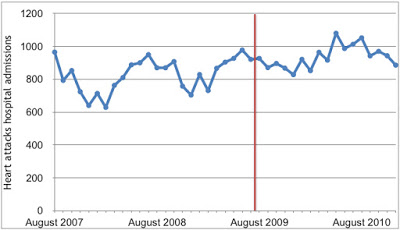
Don't forget the study in October, too, which claimed to have found a miraculous reduction in heart attacks and hospital admissions following a smoking ban in São Paulo despite the data showing quite the opposite.


And, to bring us bang up to date, the claim made in Tobacco Control this month that vaping is “a one-way bridge to cigarette smoking among youth". Never mind that the research actually showed that - out of 347 non-smoking youngsters - they could only find four who had vaped and then smoked up to two (yes, 2!) cigarettes in the following year, and not a single youth who had gone on to become a regular smoker.

We could go on and on. How impossible heart attack 'miracle' junk studies are routinely to be seen in Tobacco Control but studies saying that plain packs "do not change smoking behaviour" will not make the cut. How fantasy nonsense follows incompetent wibbling follows bare-faced lies into the pages of Tobacco Control, unstemmed by any meaningful peer review, immune to reality, and unhampered by shame or embarrassment.

Yet Ruth and her colleagues seem to be saying that these things should only be tackled in the sterile atmosphere of the BMJ's 'Rapid Responses' facility where they can decide which remarks to allow and which humiliating junk debunking to suppress. In fact, so irritated are they at individuals having their say without the control part of tobacco control being able to stop it, that their (rather predictable) response is to withdraw even further into their echo chamber. They've thrown the toys, spat the dummy, and now want their ball back.
As a result of discussion about these issues, the Tobacco Control editorial team has now established a policy that editors will not respond to external blog posts or social media messages about specific studies.
If you've ever tried to engage with a tobacco controller on Twitter, you might look at the length of your block list and piss yourself laughing that they claim to even bother responding on social media at all. But this seems to say that - with the intense amount of execrable bullshit they've been publishing of late - they are feeling the heat and officially removing themselves from the kitchen.

Yesterday's article, funny as it is, tells you quite a lot about the mindset of those at Tobacco Control. They like having the microphone; you are to be spoken to from on high, not to wrestle the microphone from their grasp and go doing your own thing. They do the telling, you do the listening, and if you want to criticise it must be done in the way they direct you to or you are not to be listened to at all.

It's never been about health, and the biased and deceitful pages of Tobacco Control have never been about truth. Objectivity? There's never been any. Credibility? Do me a favour.

UPDATE: 

Further reading on this subject here:

Editors of Tobacco Control admit they publish indefensible junk science - Carl Phillips
Tobacco Control Journal: There Can Be No Legitimate Discussion of Our Articles Without Our Permission - Michael Siegel
Denial of the Echo Chamber - Facts Do Matter
Hey Ruth. This one is for you. - Storm
Open Letter to Ruth Malone - Facts Do Matter (Guest)


Monday, 20 February 2017

How Tobacco Control 'Science' Works #94

Earlier this month, I briefly mentioned merchant of doubt Simple Simon's master class in cherry-picking 'evidence' in The Conversation to claim that truths about e-cigs are actually myths.

The comments under the line have since been quite a story in themselves, with Greek scientist Konstantinos Farsalinos revealing that he is embarking on the task of replicating some of the studies which led to garish scare stories in the media.

Click to enlarge

Established scientific convention dictates that research criteria should be made available to other scientists so they can check the results by exactly replicating the methodology to confirm its authenticity. It would appear that Farsalinos isn't too impressed with what he is finding while doing just that.

He is also having a lot of trouble with the authors of a recent study into flavourings in e-cigs. In short, they don't seem willing to disclose which products they tested, as Farsalinos mentions in the comments at The Conversation.
The authors published  a study showing 10,000-fold higher aldehyde levels in flavored vs unflavored liquids. It is not just the difference that matters; the levels reported are HUGE. Up to 7000 ug/g formaldehyde, up to 3500 ug/g acetaldehyde. If this is verified, i will be THE FIRST to openly and publicly recommend against the use of flavored e-cigarettes. When i say verified, i mean finding similar (not necessarily identical) aldehyde levels. Even 40% or 50% less would still be extremely high, and i would consider that a verification of their findings. 
So, why is the author repeatedly denying to reveal which liquids they tested? Publicly. The main author says that 5 samples are mentioned, but those were cigalikes and only 1 had problems. The crucial issue is to replicate Brand I in their study. Besides the public comments, i have personally sent 2 very polite emails (dates: 11 November 2016 and 25 November 2016) to the first author requesting information about the samples tested. I NEVER received any response, and it is the first time this is happening to me.
In the comments to the research itself, Professor Peter Hajek has also asked why "repeated requests" about the exact brands and flavours being tested are being ignored. The reply from lead author, Andrey Khlystov, either shows a laughable lack of knowledge about the subject matter, or an alarming unwillingness to allow his research to be replicated.
Contrary to what you suggest, there is little value in testing exactly the same liquids. Testing specific liquids or flavors was not the point of our study.
It may not have been, but to replicate the study it is essential that the liquids tested must be revealed. All that Khlystov will say is that they can be bought at this website. There are thousands of different liquid flavourings, all at varying levels of nicotine strength and differing blends of VG, PG, with differing viscosity and behaviour. With the generally piss poor understanding of how e-cigs work amongst tobacco control researchers, it's more that possible that these guys could have been pumping gloopy liquid through a low capacity power source and not even be aware of their fuck up (it wouldn't be the first time). To say, then, there is little value in testing exactly the same product is quite bizarre

You have to wonder why the secrecy. If he's confident in his results, why wouldn't he want the experiment to be replicated?

Not releasing the names of the liquids tested to another researcher is scientifically reprehensible; not releasing the names of liquids - which the study's own conclusions consider dangerous - is morally corrupt and incredibly irresponsible.

Imagine, for example, that one particular flavour is found to be extremely dangerous, someone dedicated to protecting 'public health' should be keen that the warning was spread widely, yet the authors of this study don't seem concerned with that, instead wishing the message to be directed at all flavours.

Do you reckon there might be an agenda at play here? It's almost as if they don't really care much about health at all, huh? It's certainly one to watch with interest. 


Sunday, 11 December 2016

Dick's Law: A Proposal

Let me show you a few tweets from recent days, because y'see, I think we have a problem within 'public health' debate that needs to be solved.

Here is John Ashton of the Faculty of Public Health (you remember him, surely?) on Friday ...


This is with regard to last week's appalling US Surgeon General report on e-cigarettes which had more holes in its 'evidence' than a Swiss cheese, most notably its complete absence of a citation for April's Royal College of Physicians report.

You would think, wouldn't you, that a UK 'public health' professional would be more predisposed to trust the RCP than a political appointee from across the Atlantic, but then Ashton hates vaping and vapers with a passion so didn't do that. Instead, he cast a tweet into cyberspace deliberately trying to smear any positive view of vaping as having come from the tobacco industry or those who support it.

It was the same approach taken by Luke Clancy of ASH Ireland yesterday.


Just like Ashton, Clancy summarily dismisses not only the RCP report, but also the conclusions of the PHE report on e-cigarettes of August 2015. Just a load of rubbish, according to Clancy. Again, this is intended to dismiss serious research to avoid debate because - as far as we know - Clancy has never conducted his own research or evidence review of e-cigs, so is relying on the opinion of others.

The opinion of others he is alluding to is, of course, that of Simon Capewell and Martin McKee who published criticism in the Lancet and BMJ following the PHE report, and it was based on nothing more than desperate smears (as we found out by FOI).

As Clive Bates commented last year on this subject.
Given the Lancet and BMJ are the giants of UK medical publishing,  might we have expected them to take a scientific perspective and look into whether the 95% claim is actually realistic?   They didn’t bother with this at all. 
In fact, there has been an interesting debate about whether this figure is right or not and if it has been expressed with the proper nuances, but not in the BMJ or Lancet
But here’s the thing: most of the legitimate concern is that this estimate overstates the residual risk of 5% and that a range should have been given, rather than a point estimate.  This is because no likely pathway for serious disease has so far been established and it is quite possible that e-cigarettes will be 99% or 100% less risky than smoking.  
Did the BMJ or Lancet provide any insight or reflection on these figures or on the proper formulation of a message useful to the public? No and no.
This isn't a new tactic, far from it. The tobacco control industry has pumped out an enormous catalogue of junk science for decades and, as a result, has actively sought to silence any meaningful debate on all of it. It doesn't matter how rigorous the science which disagrees with their chosen view may be, it will always routinely be dismissed by way of distraction and playing the man not the ball. It has rightly been compared to McCarthyism by many different commentators.

So successful has this mendacious tactic been that the BMJ now refuses any research - however scientifically perfect - merely on the basis that it is funded by the tobacco industry (but not if it is funded by other industries such as pharma, natch).

Here's another recent example, this time from a colleague of the US Surgeon general, piqued that former head of the Framework Convention on Tobacco Control holds the new e-cigs report in contempt.


As always, criticism is not followed by debate, but instead instantly leaps to a veiled smear that the person opposing the 'public health' professional's pre-conceived position must surely have been influenced by industry.

None of those above actually believe it; it's just a way of ensuring the debate doesn't get past square one and, therefore, out of their control.

It's not just in tobacco control that this goes on. In fact, the same dissent-silencing tactic has been enthusiastically taken up by everyone who has a policy they like but for which the evidence is subject to debate. In almost all cases the proponents of these policies will point to how popular they are while dismissing the idea that if the public were truly in favour, their services would not be required because people would be doing what 'public health' wants anyway. When the public do object to these vested interest obsessives, however, they too will be accused of being 'astroturf' or somehow being in the pay of industry; their voice will be ignored and all sound reasoning or evidence-based arguments discarded.

So much has this absurd fallacious form of discourse infected intelligent debate these days that it is vomited out even when it's quite laughable to do so. See this hilarious exchange from Thursday.


There you have Adam Cleave, who openly declares he works for Imperial Tobacco, being told repeatedly that he is quite obviously a front for the sugar industry. You couldn't make this stuff up! It is said without thought; without even cursory fact-checking; and is designed solely to shut someone up who holds a differing opinion.

There is no sharing of ideas or back and forth of evidence with people who immediately spring to the ad hom as a means of defence, they quite simply don't want to have to go to the bother of justifying their point of view. It is lazy, unprincipled, and a form of lying.

So I have a proposal. Just as Godwin's Law dictates that comparisons with Hitler are inappropriate and lazy debate-killers, so should anyone screaming about mythical and shadowy industry interference be equally ridiculed. I call this proposal Dick's Law and it goes like this.
"If, when faced with someone who opposes your point of view and does so by providing personal testimony, references or evidence, you reply without refuting their stance with meaningful justification, but instead accuse them of being in the pay of industry or part of a front group without any proof, you are actively attempting to strangle debate and silence discussion. Furthermore, even if the opponent is in pay of industry or part of a front group, you must disprove their opinions by way of evidence and references of your own. If you cannot do so, you have illustrated that your opinion is not supportable by facts and is therefore too weak for the debate that you have chosen to avoid. As such, at the exact moment you rely solely on an ad hominem attack on their real or imagined industry affiliation, you immediately lose the debate."
I think that works well, whaddya reckon?