Showing posts with label Shilling. Show all posts

Wednesday, 2 March 2016

Vapid Anti-Vapers; Vapid Government; Vapid EU

You may have read here often that the incessant state-funded campaigns against smoking - and state-funded assaults on any other enjoyable legal product for that matter - have absolutely nothing to do with health. Well, it seems The Times is now coming to the same conclusion.

In a superb editorial yesterday, the newspaper excoriated the coalition of the stupid, insane and corrupt lined up against e-cigs.
The big tobacco companies, the health regulators and governments have not agreed on much. They have, however, formed an unhealthy alliance to prevent the spread of e-cigarettes.
They forgot to mention pharmaceutical industries which lobby for legislation to protect their limp and pitifully unsuccessful products too, but we'll forgive the writer that considering the rest was a forthright condemnation of the vested interest-riddled, weepy willow shitsacks who dream up fantasy panics to agitate against vaping.
Tobacco (and more so pharmaceutical - DP) companies are worried that their revenues are going up in smoke. Health regulators worry that inhaling nicotine vapour might be a gateway to smoking tobacco. Governments rely on the taxes that tobacco provides. The evidence against this alliance is now overwhelming.
Indeed it is, as I mentioned just last week.
[NCSCT] also points out that recreational use of nicotine is nothing much to worry about, because it's not. This is now the position of government advisers PHE and also the state's network of Stop Smoking Services
Which makes The Times editorial's denouement pretty much perfect.
The case against e-cigarettes is wrong in the abstract. Nicotine is a legal drug and so is the ingestion of its vapour. The task of government is to provide good information and to help people to cease activities that are damaging to them. If people then want to use e-cigarettes, they should be allowed to. 
They are proving themselves to be successful in helping people to stop smoking while respecting individual freedom. Public Health England is right. Vaping should be encouraged and the lobbyists seen off.
Quite.

As an aside, the editorial was entitled "Vapid Anti-Vapers" which is inadvertently humorous considering the prior witterings of a certain loathsome Aussie rust-jointed walking carcass you may have heard of.


Back atcha, Chappers, you decrepit fruitfuck, you.

So we in the UK seem to be presented with a bit of a disjointed situation. The government's prime 'public health' advisers, PHE, are in favour of encouraging e-cig use; the government's boots-on-the-ground local service providers, NCSCT - entrusted with taxpayer funding to deliver the government's apparent objective of reducing smoking prevalence - are in favour of encouraging e-cig use; and an established and globally-respected news outlet is also now in favour of encouraging e-cig use.
E-cigarettes should be welcomed as a good way to stop smoking
Indeed, even the Prime Minister himself has said the same!
"I think we do need to be guided by the experts. We should look at the report from Public Health England but it is promising the see that over all, one million people are estimated to have used e-cigarettes to help them quite or have replaced smoking with e-cigarettes completely. 
"So I think we should be making clear that this is a very legitimate path for many people to improve their health and the health of the nation."
Well why isn't the government "guided by the experts" then? Why is the government position still dedicated to forcing smokers to "stop using nicotine completely" and of the ignorant opinion that "addiction to nicotine, we would consider harmful"?

In fact, why - as again highlighted by The Times - is the government actively working at EU level to kneecap e-cigs and effectively ensure that the financial attraction vaping offers is wiped out?
Electronic cigarettes are set to soar in price under plans by Brussels to tax them at the same punitive rate as tobacco. 
Vaping will be brought into line with cigarettes and cigars as the EU tries to help governments to raise more money.
Raise more money? Fancy that!
Experts say that a tax rise will damage public health because higher prices will discourage smokers from switching to vaping. A report published yesterday shows that in Britain about 20,000 smokers a year give up because of e-cigarettes — as many as quit through all other stop-smoking aids combined. 
However, ambassadors from all 28 EU countries have agreed to take the first steps towards imposing higher duty, quietly telling the European Commission to come up with plans by next year to reclassify e-cigarettes as tobacco products for tax purposes.
All of them? Including the UK? Well yes, it does mean that.

The UK ambassador to the EU is Ivan Rogers - appointed by the UK government to collude with other unelected EU ambassadors on issues such as this one - and there he is agreeing with all other member states that e-cigs have to be included in the Tobacco Tax Directive and nobbled. In order to raise more money for the government and bow down to tobacco control's best mates in big industry, the UK government seems happy to abandon their stated position of encouraging smokers to quit and instead vandalise a route which has proved successful for many tens of thousands of people.

As with anything to do with the EU, the public have no say.

I'd say the UK government - if it is taking David Cameron's words in parliament seriously - should indeed be guided by the evidence just as PHE, NCSCT and The Times have been. But - and I get rather tired of keep pointing this out - it's never been about health, so they are doing the polar opposite. And there's not much sign that they will be guided by what The Times rightly describes as "overwhelming" evidence in the future either, especially when they can continually bypass democracy by scurrying off to the EU and demanding more stupidity.


He's not wrong. Can we leave yet?


Sunday, 21 February 2016

"Deciding Who Lives And Dies"

In customarily melodramatic anti-smoker style, Cancer Research UK recently released a video designed to raise cash ... for their friends in the state-funded tobacco control industry.

Entitled "Could you decide who lives and dies?", it's a typical example of the industry's overwrought shroud-waving bullshit, as you can see.


The blurb accompanying the clip claims that there is such a dire shortage of funding that they're having to turn smokers away!
With cuts to public health budgets, Stop Smoking Services can no longer be offered to everyone. Someone has to decide who gets help and who doesn’t. 
I'm sorry but that smells like dustbin juice to me. If you tell your doctor you want to quit smoking, watch how quickly he'll sign you up to a meeting with a stop smoking counsellor. Faster than you can say '20 Lambert & Butler please' I'd wager. And you'll get an appointment far easier than the one with your doctor!

Of course, what the CRUK vid doesn't tell you is that there is a perfectly reasonable - and entirely justifiable - reason for the cuts.
A sharp decline in the number of smokers using an NHS support programme to help them quit has been linked to the rise in popularity of e-cigarettes. 
Nationwide figures have shown a similar trend to those in the south west of Scotland. 
In 2013, the Information Services Division reported that the number of attempts to stop smoking had fallen by 13% compared with 2012.
It's quite simple. If no-one wanted to quit smoking there would be no need at all for stop smoking services, and the same principle applies if there is a decline in demand. If there is a decline of 13 per cent then quite obviously the services will require fewer resources, probably in the region of around 13 per cent funnily enough.

So what level of cuts are being applied then? Well, they're not very savage according to ASH.
Overall, smoking cessation budgets were down: in 39 per cent of local authorities, smoking cessation budgets had been cut compared to only 5 per cent where they had increased. They stayed the same in 54 per cent of local authorities. More than a quarter of local authorities (29 per cent) had seen cuts of more than 5 per cent. 

5 per cent seems to be quite a paltry figure under the circumstances. We don't know what the upper end of the level of cuts is because ASH only mention those exceeding 5 per cent. Presumably, if some authorities had cut by 10 per cent or more ASH would have chased a headline by saying so.

Therefore, considering a decline in demand of 13 per cent, in real terms most - if not all - smoking cessation services are now better funded than they were before.

Hardly deciding "who lives and dies", now is it? If anything, those statistics above make a great case for there being scope for more cuts to better reflect demand.

A better example of "deciding who lives and dies" can be seen in Belgium, however, where tobacco control industry policies have bred and nurtured a quite disgusting decision.
In Belgium, patients with lung fibrosis will not get reimbursed for a treatment if they have smoked in the last 6 months. The smoking abstinence will be controlled by a urine test, which needs to be negative to open rights to reimbursement of the drug. 
The former secretary-general of the French Society of Tobaccology (SFT) confirms that the urinary tests incriminate all nicotine consumers, including former smokers who continue to use substitutes such as patches or gums, and vapers.
Be in no doubt, the tobacco control industry are solely responsible for this kind of vile social eugenicism. Their sustained campaign of bullying and 'denormalisation' of smokers has encouraged behaviour which would be considered appalling if directed at any other section of society.

In Belgium, they really are "deciding who lives and dies", unlike the paltry cuts referred to in CRUK's pathetic video which amount to no such thing.

So, to answer CRUK's question, "Could you decide who lives and dies?". It appears from their video that the public would find it an unconscionable and detestable thing to do. However, the 'public health' community in Belgium (and elsewhere) seem to have no trouble with it at all.


Thursday, 28 January 2016

Capewell, Ireland, Their Pharma Friends And Vape Bans

You may recall that in December we found out Martin McKee and the Chief Morality Officer Sally Davies had conspired to try to stop Public Health England from seeking filmed opinions about e-cigs, from tobacco controllers, presumably because they knew that many would be positive.

For those ideologically opposed to vaping this is something which had to be crushed, Sally Davies particularly didn't want it to see the light of day, as I mentioned at the time.
Stating to McKee that she had contacted the organisation and "was clear that [PHE] should not go ahead", she then - incredibly - asked if McKee could enlist the help of the Faculty of Public Health to deter PHE from continuing with the idea. McKee, of course, was quite happy to do so and called on now-President of the FPH, John Middleton, to assist.
Now, we know that FPH are absurdly opposed to e-cigs as their former Chairman shared that info one wild and wacky, tired and emotional Saturday night back in September 2014. So it wasn't much of  surprise that his replacement, Middleton, would be more than happy to be a health-be-damned merchant of doubt too.

However, the December FOI also mentioned someone else who is very eager to create as much fear and confusion about e-cigs as possible.
John Middleton, Robin Ireland and I have been doing almost non stop media interviews (and of course the blogs and tweets are having a field day, photoshopping my face onto all sorts of things...) 
OK, stop sniggering about the photoshop bit for a moment and consider that reference to Robin Ireland. If you don't know him, he is prime propagandist at the Health Equalities Group which has a Twitter timeline that Chairman Mao would be proud of for its incessant barking of junk science on everything from e-cigs to 7Up. Robin himself is no slouch in that respect either, I can recommend you following both to observe their screaming insanity on a daily basis.

Well, Argvargen has been looking into Robin Ireland's organisation and found some very interesting info.
The Health Equalities Group comprises Hearts of Mersey, HM Partnerships and Healthy Stadia, which are wholly owned subsidiaries of the umbrella “charity”, as well as Food Active, which runs the truly pathetic GULPnow campaign. It is run by Robin Ireland, and lo and behold, one of the trustees is none other than the hashtag-haiku-tweeting phenomenon that is Simon “Capslock” Capewell. HoM/HEG is partly funded by the taxpayer, via tasty grants from a number of the North West Directors of Public Health. (Getting very cosy this, isn’t it!)
Simon Capewell, did he say? Trustee of Health Equalities Group? Who is also on the board of the FPH who McKee enlisted to try to get positive opinions of e-cigs silenced? Say it ain't so!

Argvargen continues ...
It is also happy to take “kind contributions” from Pfizer:
Yes, you know, the makers of nicotine patches and gum. In fact, Argvargen's investigations show that organisations under the control of Robin Ireland regularly receive cash from pharmaceutical companies, and not restricted to Pfizer either. Do go have a read.

What particularly struck me though was the mention of Healthy Stadia and how they are funded.
In 2005/6 Heart of Mersey put in a bid for with the EU’s DG SANCO for another sack of taxpayers’ cash for their Healthy Stadia project. DG SANCO didn’t have any sacks, so they sent a truckload. €532,000 to be precise. 
So what do vapers & smokers have to fear from Healthy Stadia? Put simply, they actively, aggressively and successfully encourage football, rugby, cricket and other clubs to ban smoking and vaping in any indoor or outdoor part of their sports stadia and surrounding areas. That’s right – if you’re planning on visiting Euro2016 this summer, you won’t even be allowed to vape in the concourse outside the stadia. and it’s all thanks to the shitpuffins at Healthy Stadia. It’s a horrendous policy that divides rather than unites sports communities and exemplifies the unscientific, fanatical and frankly inhuman creatures that dominate the public health industry today.
You see, some will know that I am a cricket and rugby fan so am acutely aware of how this group's badgering of sports venues has resulted in such fascist illiberal bans. So much so that in 2014 I enlisted the help of a fellow jewel robber to ask what Healthy Stadia had done to encourage outdoor vaping bans in particular. Their spokesman, Matthew Philpott, was adamant that they only "consulted" the clubs as to their policy.
We have not carried out consultation with fans concerning use of e-cigarettes at stadia, only with individual clubs and governing bodies.  
I should also state that we have not been instrumental in directing UK clubs to ban e-cigarettes – we have simply conducted consultation on their current policies regarding this matter.
Follow up questions asking for evidence of the material they sent to the clubs concerned was ignored, so I contacted a few clubs to ask exactly what Healthy Stadia had sent them. You won't be surprised to learn that it didn't correlate with Philpott's innocent explanation.
The advice they gave us was that e-cigs still normalised smoking and guided us to our Council Public Health views which was not to encourage. 
Advice? Erm, I thought it was just consultation.

It all becomes clear when you read, via Argvargen, how Healthy Stadia has been funded.
And what do you know? Robin’s Healthy Stadia is also funded by patch floggers. Yes indeed ladies and gentlemen. Vape-free stadiums, brought to you in association with and thanks to funding from the makers of Nicoderm

So here we have an organisation which is strapped for cash, taking money from a pharmaceutical company which makes nicotine replacement therapy, and advising sports venues - bypassing fans altogether - to cease the practice of vaping in all areas inside and outside. Seems legit, eh?

Now, considering the huge conflict of interest taking pharmaceutical money and then advocating bans on e-cigs in stadia represents, do you think they should be advertising that they enjoyed "success in engaging, informing and influencing North West MPs and MEP in relation to a number of tobacco control issues including the Tobacco Products Directive"? Do you think they should be shouting out how brilliant they think proposed Welsh vaping bans are? Additionally, don't you find it hilarious that HEG trustee Simon Capewell was one of the authors of a smear article in the BMJ based solely on lamely questioning the conflicts of interest in one study out of hundreds referenced by PHE's positive report on e-cigs?

And considering Robin Ireland appears to be desperate for funding and eager therefore for pharma cash, isn't it absurd that he should be consorting with the proven liar McKee to spread doubt and fears about e-cigs, let alone actively encouraging their being banned?

Incredibly, these people have the gall to accuse tobacco, drinks, food and soda companies of being corrupt. It truly beggars belief, doesn't it?

H/T Argvargen, see his articles here and here.


Monday, 12 October 2015

Remote Control Begging

Yesterday saw the rare occurrence of those weekday nine-to-fivers finding something urgent to tweet about on the day of rest.


This is because the BBC faithfully covered the pitiful sight of a vacant MP holding out a begging bowl for ASH.
Tobacco tax increase urged by parliamentary group
Tax on tobacco should be raised to persuade more smokers to quit, a parliamentary group has said. 
The tax rate currently goes up by 2% above inflation each year, but the All-Party Parliamentary Group on Smoking and Health wants that increased to 5%. 
It says an extra £100m per year would be generated to spend on anti-smoking projects
Would this be the All-Party Parliamentary Group on Smoking and Health which is secretaried by ASH and is just a mouthpiece for whatever their latest piece of anti-smoker gobshitery happens to be? Indeed it is.

So he wants his government to raise tobacco taxes so that an extra £100m per year would be raised to spend on anti-smoking? Like projects that his puppet-master ASH might benefit from you mean? What a fine example of democracy in action that is, I'm sure poodle Bob has also been instructed how proud he is supposed to be with himself for this selfless display of getting ASH's noses further into the tax trough.

Meanwhile in Ireland.
What this means is that, over the past eight budgets and two governments, much-vaunted tax increases on tobacco have, in reality, left Ireland with a budget gap of €367 million.
Is that so?
As the price of a pack of cigarettes has risen over the past decade or so, tobacco smuggling and non-Irish duty paid cigarettes – sometimes sold at half the retail price – have undergone something of an explosion. 
In 2007, the percentage of cigarettes coming from untaxed trade was 6.7%, according to market research company Euromonitor International. 
Over the next two years, successive tax hikes increased the price of a pack by 50 cents, 30 cents, and 75 cents. 
And the untaxed share of the market rocketed to 19.8% by 2009. In 2014, it was just over 23%.

Who cares though, eh? It's not really about health is it, just about how much ASH can screw out of government - and now, smokers - to stuff their fat pockets with.

UPDATE:

Simon Clark had some excellent points to make on BBC Breakfast about Bob Blackman's pathetic simpering on behalf of ASH. Definitely worth a watch.


Wednesday, 9 September 2015

Pulling The CMO's Strings

It seems I may have been a trifle harsh on our Chief Medical Officer Sally Davies.

You see, in the past I've questioned her fitness for the job due to her stunning ignorance when it comes to e-cigs. However, my thanks must go to fellow jewel robber AT - someone who has shared FOI requests with me in the past - for shedding some light on why Sally might have been making such absurd and evidence-free pronouncements.

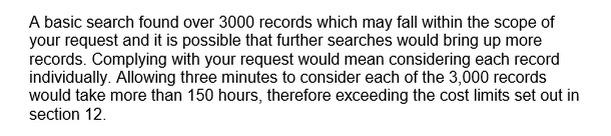
You see, when asked by AT for correspondence between Sally and Martin McKee about e-cigs and vaping from January 2014 till the present, the Department of Health rejected the request on the following grounds.


3,000?!? 3,000 records over 19 months and there could be more? Crikey O'Reilly, they've chattering away on a daily, maybe even hourly, basis! There are married couples who don't converse as much as that!

It puts a new slant on Sally's silliness now, doesn't it? McKee is an ideological buffoon who has never had a positive word to say about e-cigs or the concept of tobacco harm reduction, is widely suspected to be co-author of the laughable Lancet smear job on Public Health England's recent supportive report on vaping, and enjoys stifling debate by beating up on part-time waitresses from Cornwall.

So when Sally said vapers should "grow a backbone" and quit smoking instead of using an e-cig at the Public Health England forum on e-cigs in early 2014, she was just parrotting McKee's garbage.

When Sally said this ...
"We do not yet know the harm that e-cigarettes can cause to adults, let alone to children, but we do know they are not risk free," Prof Dame Sally Davies, England's chief medical officer, said. 
"E-cigarettes can produce toxic chemicals and the amount of nicotine and other chemical constituents and contaminants, including vaporised flavourings, varies between products - meaning they could be extremely damaging to young people's health."
... she was merely repeating zombie arguments from McKee without checking they were actually valid.

When she declined to comment on this Guardian article on the subject, it was probably because McKee had already accepted the invitation so she would only be saying the same as him.

And when she said this ...
Why are you against increased use of e-cigarettes?
If they were properly regulated as a medicine and we knew what was in them and the dose of nicotine, then they might play a useful role in stopping smoking. But they aren't, so at the moment we don't know their safety or the dose they deliver. They are often aimed at children with their flavourings – not only menthol but cookies and cream and bubblegum. They are sold rather cheaply and many of them are made in China, so I worry about what is in them. We have even got a verb for e-cigarette use: to vape. I am worried about normalising once again the activity of smoking. This matters particularly with children and adolescents. 
So you are worried this could be a rerun of socially acceptable smoking?
Yes. Have you seen the adverts for e-cigarettes? They make them look cool and chic. In the Metrocentre in Newcastle they have a vaping boutique, which looks like a perfume boutique.
... it was just McKee's constant rabbit getting in her ear and pulling her strings. How did we miss such a big clue as 'bubblegum', eh?

All of which suggests that I may have judged Sally harshly. There I was thinking she was not fit for the job and should be sacked for not looking at the evidence or hearing what experts have to say, but she was. It's just that she chose to listen - up to 5 or 6 records per day(!) - to an evidence-avoiding, self-proclaimed 'expert' who only turned up in late 2013 and "is much less interested in 'public health' than he is about fighting a private war against industry".

As you were then, it's not her calm assessment of the evidence which is lacking, just her judgement.


Thursday, 16 April 2015

Another Incompetent Chief Medical Officer

It would appear that the Welsh Chief Medical Officer, Ruth Hussey, is as incompetent as England's version when it comes to e-cigs.

From the BBC (complete with video):
E-cigarettes could normalise smoking among a generation which has grown up in a largely smoke-free society, according to the Welsh government's chief medical officer. 
Dr Ruth Hussey was responding to a Cardiff University study which found 6% of pupils aged under 11 said they had used e-cigarettes, compared to 2% who had tried tobacco. 
"This research demonstrates that e-cigarettes are being used by young people who have never smoked," she said.  
"We should be doing everything we can to prevent a new generation becoming addicted to nicotine," Dr Hussey added.
Really, Ruth? This is the information you are happy to spew out to our national broadcaster? Because I've read the study - it's here for anyone else interested - and it 'demonstrates' that Hussey is being economic with the truth.

It sampled 1,601 primary school kids and 9,055 secondary school students in Wales and found that a tiny 2.1% of the former had used an e-cig more than once ever, while only 1.5% of the latter used e-cigs more than once a month (125 of them). Of those, only a vanishing third of one per cent had never previously smoked. So, wouldn't her sentence have been more accurate if she had said.
"This research demonstrates that e-cigarettes are being used by 0.3% of young people who have never smoked"
At which point, we would all breathe a big sigh of relief and think, you know what, if they weren't using e-cigs they'd probably be experimenting with tobacco or cannabis anyway, so nothing to see here. It's hardly of epidemic proportion, is it?

Alternatively, perhaps Hussey could have called the study authors for guidance, because they make it quite clear that Hussey's message is definitely not the one they want to convey.
However, it is important to note the low prevalence of regular e-cigarette use, which suggests that e-cigarettes are unlikely to make a major direct contribution to adolescent nicotine addiction at present.
So wind your neck in, Hussey, you disingenuous troll. You're creating a scare story for purposes we can only guess at. Been talking to your pharma chums recently, have you?

We'll leave the last word to lead researcher Graham Moore, shall we, seeing as Wales's CMO doesn't seem capable of reading an academic paper with any degree of competence.
"There are some concerns at the moment that the growth of e-cigarettes may be helping to get a new generation of young people addicted to nicotine. At the moment, that doesn't seem to be the case. There doesn't seem to be too much reason to worry that that's actually happening."
Tell it to the Welsh CMO who thinks there is reason to be filmed by the BBC promoting exactly that non-existent worry.

I'm surprised that, during these times of austerity, we have such a duplication of highly-paid people spreading demonstrable nonsense. I mean, how many barking Chief Medical Officers does this country really need?


Monday, 9 March 2015

The Search Continues For Dame Sally's 'People'

A clown, pictured yesterday
Back in February, Chief Medical Officer Sally "Backbone" Davies made an astonishing claim on the BBC.
“We don't yet know about vaping. I mean clearly they put in flavourings, we don’t know the impact of those. Butterscotch has had to be withdrawn because people got chronic lung disease.”
I've been extremely busy of late so must admit to having missed the extensive media coverage of this health threat. However, it seems Mark Pawsey MP did too, so on Friday he asked for more details from the Secretary of State for Health.
Mark Pawsey, Conservative, Rugby 
To ask the Secretary of State for Health, how many cases of chronic lung disease are recorded as being linked to (a) butterscotch flavoured e-liquid and (b) electronic cigarettes in general. 
Jane Ellison, The Parliamentary Under-Secretary of State for Health 
The Department does not hold the requested information.
Yes. There have been so many people going down with chronic lung disease as a direct result of using e-cigs that ... the Department of Health has no record of them! This strikes me as woeful incompetence on the part of the DoH, what are we paying our taxes for if it isn't to have these things monitored?

I mean, Backbone was very certain of her facts, and she is our calm, knowledgeable and evidence-based Chief Medical Officer, after all. She must have received solid proof of this assertion from somewhere, and if it's not the DoH, she must have some peer-reviewed studies stuffed down the back of her sofa that no-one in Westminster or Whitehall knows about. Perhaps an FOI request is in order, anyone up for it?

But then I remembered what I wrote about her in May.
Now, isn't the CMO meant to be rational and form opinions rooted in - you know, as the job title implies - dispassionate evaluation of data and science, as opposed to a media which is supposed to enjoy whipping up a frenzy based on scaremongery and junk science? The roles seem to have been reversed in this case. 
Sally's silliness has been mentioned here before, but it's now becoming increasingly clear that she is either too easily manipulated by vested interests or just plain incompetent. Either way, it strongly indicates that she is unfit for purpose, vastly over-promoted to the position of CMO, and should be fired before she does any real damage.
So I suppose it's more than possible that she was deliberately lying on the BBC.

It's a crushing indictment of the public sector in general - and the Department of Health in particular - that such a dangerously ignorant clown is paid around a quarter of a million pounds of our taxes per year.

UPDATE: It seems there is already an FOI in progress to try to find out about all those chronic lung disease cases. Dame Sally must be rooting behind the cushions as we speak.


Tuesday, 9 September 2014

Some Perspective, Please?

By way of a brief update, on Thursday I said I was unsure of David Davies MP's stance after his parliamentary question winkling out the fact that the WHO's FCTC shouldn't even be discussing e-cigs, let alone tabling bans on their use in public. I now think his motives are more clear.

For anyone not familiar with written questions, an MP is allowed to ask as many as he/she likes and they are slated well in advance in order for civil servants to compile a response for the minister concerned so have to be well-worded to avoid an uninformative reply. However, they are also limited to a certain number per day so - although an MP may want to ask dozens of questions on a single subject - the responses themselves are often released on a staggered basis. A good example is Steve Baker questioning each government department on their policies toward granting taxpayer funds to charities, as reported here in 2012.

Well, since Davies's first published response last week, others have been trickling through, and I suspect he is subtlely supportive of e-cigs.

Today's releases asked Jane Ellison if she could estimate savings to the NHS of e-cig use, and whether she has bothered to confirm or deny that passive vaping is a thing. She couldn't do either, of course, because the Department of Health outsources all its research to the tobacco control industry's domestic (ASH, Bath, Stirling, UKCTAS) and supra-national (EU, WHO), unelected ban-hunters. The way these things work, there may perhaps be more questions she hasn't a scooby about in the pipeline too, so keep 'em peeled.

There was, however, one of Davies's questions that she could answer:
David Davies (Monmouth, Conservative) 
To ask the Secretary of State for Health how many serious health events have been recorded per thousand (a) e-cigarette users, (b) users of nicotine replacement therapies and (c) users of the Champix form of varenicline in the last year.
Apparently, this is covered by the MHRA who, as we know, have studied e-cigs so closely that they're certain that all models currently on the market must be banned in 2016.

They're not so great at comparing the harms of e-cigs per capita with other nicotine products, though, so Ellison could only provide absolute figures.
Jane Ellison (The Parliamentary Under-Secretary of State for Health; Battersea, Conservative) 
The following table shows the total number of serious UK spontaneous ‘suspected’ ADR reports received by the MHRA between 23 July 2013 and 22 July 2014 broken down for E-Cigarettes, Nicotine Replacement Therapies (excluding E-Cigarettes) and Varenicline: 
Total Serious Reports
Varenicline 297
Nicotine Replacement therapy 75
E-Cigarettes 5
Five. That's it. Just five.

All that bluster about "we don't know what's in them" and "they must undergo medical regulation to ensure there is no harm". For just five - count 'em; one, two, three, four, five - recorded cases. So few they'd all fit in a London black cab.

Whereas the medically licensed - and therefore perfectly safe and ubiquitously-prescribed - NRT and Champix have contributed 75 times that many incidents in the same space of time.

Now, the latest estimate is that there are 2.1 million e-cig users in the UK, and I'll bet that there are nowhere near that many using patches or gum, and a vanishingly small number using Champix by comparison. So the increased relative risk from using pharma products over e-cigs is almost certainly well in excess of the 7,500% we can ascertain from absolute numbers.

Why, then, the huge furore over e-cigs? Where is the outrage from furrow-browed public health officials about the dangers of Champix and the irresponsible "wild west" attitude of those profiteers at Pfizer et al? Where are the demands for an immediate ban pending further intensive research?

Hello? Anyone?


Monday, 8 September 2014

The Show Must Go On ++ Updated ++

So, further to yesterday's article on Faculty of Public Health president John Ashton's public implosion, it seems the inevitable has occurred and he's realised he was being a bit of a dick on Saturday night.
Still, if anyone was under the impression that the FPH will be more receptive to opposing views on the issue of e-cigs as a result, you might need to think again.

You see, even if Ashton has been placed in the naughty corner (which I very much doubt), the doomsaying from the FPH is likely to carry on regardless - perhaps in the form of their more media-savvy former president, Alan Maryon-Davies. Here's the gullible old coot on BBC Scotland on Friday.
Our worry is that they maybe helping a lot of smokers to just perpetuate the habit because it means they can maybe smoke in places where they wouldn't normally be able to smoke and they can keep it going and perhaps lose their urge to give up because they're a pretty good way of getting the nicotine hit. 
An even bigger worry is that they might be recruiting a whole lot of young people because they are being marketed at young people with fruit flavours and bubble gum flavours.
Long term readers here will remember Maryon-Davis for his bizarre claim in 2009 to be "a libertarian by nature", just before reeling off his 'libertarian' credentials on the BBC.
Is the government 'nannying' us too much? Is it trying too hard to micro-manage our health? I say firmly - no. 
I see an increasing acceptance that we, all of us, need not only more information and guidance from government, but also more legislation to save us from ourselves. 
We need to press for more legislation to improve and protect health and well-being. We need a big stick to curb the worst excesses of the various commercial interests who shape our lifestyle. We've been largely successful with the tobacco industry, and now it's time to shift the focus onto alcohol and junk-food.
What next? I would like to see a ban on smoking in cars with a child on board and a ban on displays of cigarettes in shops. I would like to see a real hike in tax on alcohol and a ban on deep price-cuts for booze. I would like to see a wider ban on junk-food adverts around TV programmes watched largely by children. 
I would like to see a whole raft of other legislation for health.
Despite his obvious libertarian tendencies, I don't think he's going to object too much to more state interference with e-cigs, do you?

Meanwhile, John Ashton's latest cherry-picking criticism of e-cigs was published at the integrity-bereft BMJ just before the weekend. That is, the BMJ who won't accept research funded by tobacco but refuse the same rule against anything paid for by the pharmaceutical industry for some unknown reason.

Click to enlarge
Ashton made full use of the BMJ's paywall to broadcast his ill-informed views to undecided medical types, without the possibility of being challenged by those horrible vapers and their inconvenient dissent.
Many critics of WHO’s position are from the harm reduction community and see e-cigarettes as a useful contributor to tobacco control efforts. But these critics seem unable to decide whether e-cigarettes are a short term medical aid to quitting smoking or a consumer good, to be used in the long term.
Why decide when they offer both?
Images aimed at young people are reminiscent of those previously used by the tobacco and alcohol industries.
He seems very certain of that assertion. Another health pro who was present at e-cig company board meetings where they discussed ensnaring kids, perhaps? Or is he talking about adults under 30?
Stanton Glantz, professor of medicine at the Center for Tobacco Control, University of California San Francisco, says “there is no justification for reintroducing these toxins indoors after we spent 30 years getting rid of them"
Quoting aircraft engineers is e-cig control 101, it seems.
The tobacco industry’s integration with e-cigarette manufacturers is not altruistic.
This is true, they fall into the category of acting in self-interest as per Adam Smith's invisible hand. Ashton and his colleagues, however, receive no pay whatsoever and do their bansturbating for nothing but love.
Many, seemingly well informed, people appear willing to suspend disbelief about the tobacco industry’s goodwill. This issue is as much about commercial politics as science. Let us get the science right by making sure all vested interests are in the open, as we seek to improve the public’s health.
Good idea. Because with the pharma-funded WHO's dream Moscow city break fast approaching - and with the FPH's dogged resistance to any evidence-based positivity about e-cigs - it would be interesting to discuss further the 'independent financial arrangements' of the FPH and their members, not to mention the ideological anti-business agenda of far-left ideologue John Ashton.

Just sayin'.

UPDATE: Well, you just knew that Ashton wouldn't simply go quietly into the night. The Times has decided that he is just a poor wounded tobacco control soldier, bravely carrying on in the line of duty.
Public health chiefs have accused e-cigarette users of a campaign of online abuse, saying that junior scientists are being scared away from research by explicit attacks from “vapers” on Twitter.
Not all bad then? Considering the shocking quality of most tobacco control 'research' so far on e-cigs, I'd say they're the very last people who should be conducting any.
Professor Ashton and the Faculty of Public Health declined to comment ...
Very wise seeing as they have a disciplinary to conduct.
... but Professor Martin McKee, from the London School of Hygiene and Tropical Medicine, who is another critic of e-cigarettes, said: “If you say anything, they get you within minutes, there’s so many of them."
So many of them that they become a problem for the likes of McKee, yet still no evidence of any of them quitting smoking with e-cigs according to the junk scientists of public health.

They've lied so much over the years that I do believe they're starting to confuse even themselves.


Friday, 29 August 2014

The WHO Goes In To Bat For Big Pharma

Well, the World Health Organisation has finally come out of the closet and admitted that its Framework Convention for Tobacco Control (FCTC) is nothing more than a mouthpiece for the transnational pharmaceutical industry.

We've kinda known this for a while but it has always previously posed as being concerned with health by attacking tobacco. However, once again e-cigs have thrown a huge spanner in the works and the WHO has been forced to reveal its hand in the most shameful of ways.
The World Health Organisation is recommending a ban on using e-cigarettes in public indoor spaces because of fears over second-hand smoke.

It also says e-cigarette solutions with fruit, sweet-like and alcohol-based flavours – which may appeal to children – should be taken off the shelves and vending machines should be removed in almost all locations.

The ban on indoors use should be put in place “until exhaled vapour is proven to be not harmful to bystanders,” the group said.

A variety of flavours which draw users away from the taste of tobacco, and the ability to vape in many locations are the two most attractive qualities of e-cigs which make them viable. Without this there are only two options, either a huge unregulated black market or a mass migration – and I'm talking literally millions of people here – back to smoking tobacco.

This is proof positive – as if we've ever really needed it since the previous evidence-free assault on snus – that the hysterical anti-tobacco movement has never been about health (as many commenters to the linked article seem to be starting to recognise) but is driven in large part by corporatist defence of pharma industry profits from supplying the nicotine market.

Note too the methods being used here. They fabricated fear of the non-existent dangers of secondhand tobacco smoke, but have been unsuccessfully scratching around trying to find something with which to kill e-cigs too. They strove, they searched, they came up blank … so decided just to tell a load of lies again, as Prof Gerry Stimson observed on Tuesday
WHO’s mission is to save lives and prevent disease but once again it is exaggerating the risks of e-cigarettes, while downplaying the huge potential
The WHO position paper appears to have cherry-picked the science, used unnecessary scaremongering and misleading language about the effects of nicotine.

Just the same old same 'ole from tobacco control. Well, it worked last time so what can go wrong, they guess. The difference is that no-one is going to buy it; passive vaping is quite simply a non-starter, even a hypochondriac is going to struggle to find the energy to be mildly perturbed. It's quite simply not a thing, nor ever will be.

And kids, of course, the old staple. Banning fruit flavours because kids like fruit (and adults never do, oh no) but also banning alcohol flavours because even though adults consume alcohol they, err, also attract kids? It's incoherent codswallop and the public will spot it a mile off.

Sadly, the public don't get a look in - fuckwitted politicians do. So we can expect blind, ignorant caution to prevail and bans to appear all over the world. If so, history will judge these people as some of the most hypocritical, avaricious, irresponsible, dangerous and disgusting ever to have walked the Earth.

I've mentioned before that this year's WHO 'COP6' summit in Moscow is endorsing Putin's Russia while the rest of the world is imposing sanctions, but on this evidence the tobacco control industry and the pharma-shilling WHO have chosen the perfect venue location. They're a global disgrace and belong there with the bigoted, the corrupt and the inhumane.


On the plus side, trust in the WHO and their professional tobacco control hordes can only evaporate amongst right-minded people thanks to this incredible development. There's always a silver lining, eh?  


Thursday, 21 August 2014

Who's Paying WHO?

As we count down the days until the tobacco kontrol klan's next excuse to waste our money - the Sixth session of the Conference of the Parties to the WHO FCTC (aka COP6) to be held in Moscow later this year - it's been very interesting to look through some of the material which has been placed online in advance.

For the uninitiated, this is a regular event where state-funded anti-smokers from all over the world congregate to think up even more pointless batshit ideas like plain packaging. The last one was in South Korea in 2012, at which topics such as a global tobacco tax and classifying e-cigs as tobacco products were seriously considered.

These two subjects are almost certain to crop up again. In fact, the proposal on e-cigs is a gimme seeing as the WHO has been desperately trying to hide its own documents by sending cease and desist letters to websites which dare to report their plans.

So who pays for this stuff, I hear you ask? Well, you do, mostly. The Framework Convention Alliance (of which ASH is a member, by the way) has produced a budget and workplan in advance of their endorsement of the gay and passenger airline-bashing Russian state.

The document itself charts how the amount spent has more than doubled while funding from VACs - that's supporting governments to you and me - has not. In fact, the sums demanded by the WHO have often been ignored, with 20 countries not having paid a penny. It's good to see from the breakdown that the UK is in arrears by over £300k from a total of around £8m, but if you're from the USA you should thump your chest and sing the star-spangled banner as your government has refused to recognise the FCTC and has therefore paid the princely sum of bugger all. Ever.

This all causes a bit of a problem for the professional anti-smoking community, because dictating to the world - to pay for their cars, holidays and mortgages - comes at a big cost and cannot be restrained by silly concepts like living within their means.

Therefore, they have been forced to raise cash elsewhere, as they describe here.
The FCTC budget has more than doubled over the last seven years, increasing from $8,010,000 for the 2006-2007 biennium to $17,290,000 for 2014-2015
.
The total amount of Voluntary Assessed Contributions(VACs), however, did not follow this trend. VACs rose by only 12 percent in this period, while the number of Parties increased by over 50 percent. In practical terms, the larger number of Parties led to an expansion of the workplan, for which resources had to be fundraised.
Or, put in a table ...


It does kinda beg the question ... who is paying for that other 47.4% which the WHO euphemistically calls "extrabudgetary funds"? By my reckoning, it amounts to in the region of $8.5 million.

Hmm, I wonder who these phantom donors could be, huh? Sadly, even the FCA don't appear to know.
Detailed information on the fundraising strategy of the Secretariat and its progress is not available.
I'd have thought that such information is pretty darn important when we're talking about a conference which is trying to enforce rules on 176 different jurisdictions without a single vote having been cast in their direction. Because, if you're chipping in that amount of cash, I'd expect you'd demand a certain amount of control over the agenda, wouldn't you? But then, transparency has never been the FCTC's strong point.
Activities related to assistance with FCTC implementation have so far been funded exclusively by extra-budgetary income.
Activities such as proposing global tobacco taxation and classifying e-cigs as tobacco products which would advantage sellers of alternative nicotine delivery systems to tobacco and vaping, do you think they mean?

I suppose we shall have to wait and see, shan't we.


Friday, 11 July 2014

Who's Been Misleading The EU?

Now this is interesting.
European officials have been wrongly labelling e-liquid as extremely toxic. 
The civil servants had been misclassifying e-liquid as either a CLP category 2 product, alongside strychnine, or a category 3 product, alongside formaldehyde. The new report demonstrates that the acute oral and dermal toxic hazards of the strongest consumer e-liquids only merit being classed as category 4 - along with washing-up liquid - while the vast majority of e-liquid (which has nicotine concentrations below 25mg/ml or 2.5%) does not require any type of formal hazard warning.
So if mandatory toxic hazard warnings are to be required on e-liquid, the same should go for Fairy Liquid too, surely? Ha! Like we're ever going to see anything as hysterical as that from the EU.

It does beg the question as to whom the EU have been listening to if they've been proven to be so embarrassingly wrong though, doesn't it? I mean, being a huge organisation with a galactic budget they have toxicology advisers and all that jazz, so who's been feeding them duff info?

I'm sure the fact that a multi-national industry was caught lobbying the EU over the e-cigarette terms in the Tobacco Products Directive - the same industry whose products are tanking in member states due to the advent of e-cigs - has absolutely nothing to do with it.


Wednesday, 21 May 2014

Chief Medical Officer Sally Davies Is Not Fit For Purpose

Would look better holding a P45
Following on from yesterday's news, The Times today carried an editorial on e-cigs which is thoughtful and very well-informed (emphases mine).
Their use is not uncontroversial. Some feel they normalise smoking, while others insist that they allow former smokers to maintain addictions that they might otherwise have escaped. There is no evidence supporting either fear. Professor Robert West of UCL’s Department of Epidemiology & Public Health notes that some health professionals may be wary of e-cigarettes because they resemble the bad old burning weed. There is also, in a manner more sinister, resistance from pharmaceutical companies. The tobacco industry, after all, is not the only one threatened by a cheap, clean, safer alternative to cigarettes. The makers of patches, gums and inhalators have even more to lose. 
The government intends to license e-cigarettes as medicines from 2016, having by then come to a more advanced understanding of any risks they may carry. Certainly, their safety should be investigated and the sooner doctors can start prescribing e-cigarettes to smokers desperate to quit the better. Yet, much as a powerful pharmaceuticals lobby might like it if they were so classified, e-cigarettes are not quite medicines and there is a risk inherent in treating them as such
Electronic cigarettes have thrived precisely because they can be sold cheaply and almost everywhere. While some use them in the hope of ending nicotine dependence altogether, others have no such intention. In either case, they have the potential to represent a formidable advance in public health. This time there really could be smoke without fire.
Compare that calm and considered assessment of the debate with this one from Chief Medical Officer Sally Davies two months ago, where she simply repeats the fears for which The Times quite rightly reports that there is no evidence.
Don't let vaping, obesity and boozing become norms
Why are you against increased use of e-cigarettes?
If they were properly regulated as a medicine and we knew what was in them and the dose of nicotine, then they might play a useful role in stopping smoking. But they aren't, so at the moment we don't know their safety or the dose they deliver. They are often aimed at children with their flavourings – not only menthol but cookies and cream and bubblegum. They are sold rather cheaply and many of them are made in China, so I worry about what is in them. We have even got a verb for e-cigarette use: to vape. I am worried about normalising once again the activity of smoking. This matters particularly with children and adolescents. 
So you are worried this could be a rerun of socially acceptable smoking?
Yes. Have you seen the adverts for e-cigarettes? They make them look cool and chic. In the Metrocentre in Newcastle they have a vaping boutique, which looks like a perfume boutique.
Gasp!

And this is without mentioning rumours I've heard of her abject and insulting performance at the Public Health England forum on e-cigs recently.

Now, isn't the CMO meant to be rational and form opinions rooted in - you know, as the job title implies - dispassionate evaluation of data and science, as opposed to a media which is supposed to enjoy whipping up a frenzy based on scaremongery and junk science? The roles seem to have been reversed in this case.

Sally's silliness has been mentioned here before, but it's now becoming increasingly clear that she is either too easily manipulated by vested interests or just plain incompetent. Either way, it strongly indicates that she is unfit for purpose, vastly over-promoted to the position of CMO, and should be fired before she does any real damage.


Monday, 14 April 2014

E-Cigs To Be Classed As Tobacco

It appears that the World Health Organisation has jumped the shark and is now entirely under the control of their pharmaceutical industry paymasters.

Via the Financial Times, I challenge any tobacco controller to say that this is a proportionate response to something which is helping hundreds of thousands of smokers to quit tobacco.
Electronic cigarette users are set to be banished to the pavement alongside their tobacco-smoking cousins – and face similar hefty prices – if the World Health Organisation pushes ahead with plans to regulate e-cigarettes in the same way as normal tobacco. 
Attendees at the meeting, which included representatives from the WHO’s six global regions, said that e-cigarettes “would be considered as tobacco products as per the WHO FCTC” if they contained nicotine made from tobacco leaves, according to the minutes. 
The move would see e-cigarettes face the same advertising bans, public smoking limits and hefty excise duty that apply to normal cigarettes, potentially stymieing the products’ rapid growth.
Conveniently, this is just what the pharmaceutical industry needs to halt a dramatic decline in sales of their useless, but expensive, rival products. What a coincidence, eh? And what's the betting that if this is true, the WHO commission 'science' to justify it from someone like, oh I dunno, mad Stan Glantz?

Now, I hate to crow (actually, I don't) but I saw this coming way back in 2008. It has been written in the public health scriptures that the only supplier of nicotine shall be the pharmaceutical industry, even though they too procure their nicotine from tobacco leaves.

Bravo to e-cigs and vapers everywhere for flushing these charlatans out. Their claimed care for health is merely the front for a charade which often resembles a shilling exercise for Big Pharma. If not, I dare ASH and chums to prove me wrong by objecting to these proposals in the strongest possible terms. In fact, scratch that, I double dare you.

Quite how throwing vapers out into the street is supposed to protect those poor choice-free bar workers from the already mythical secondhand smoke terror, the article doesn't say. Just a hunch, but I'd say bar workers have been used like a cheap whore by a tobacco control industry which has never been about health.

The message this is sending is that you may as well carry on smoking - if anyone tries to put you off, just advise them that the World Health Organisation told you to.


Wednesday, 26 March 2014

Two Slippery Slopes Confirmed In One Day

It looks like tobacco control's Myth 7 has finally been put out of its misery.

Via Reuters.
Plain packaging is seen by public health advocates as the dawn of a new era of restrictions on unhealthy products, and many observers expect a similar campaign against marketing of alcohol and unhealthy foods if the anti-smoking drive succeeds.
OK, it was always an open secret, but it's nice to have it all out in the open now.

The article also shows up one of this blog's figures of fun as more of a clown than we already took him for.


Which is not strictly true. In fact, it's laughable fantasy - but we have to make allowances for the addled old nerk, perhaps he's struggling with that new-fangled internet thingy. If only he'd tried Google before burbling.
Ukraine asked WTO Director General Roberto Azevedo earlier this week to nominate panel members, and Australia said it would ask Azevedo to do the same for Honduras and join the two cases together. 
Despite the change of government in Kiev, Ukraine's representative at the meeting said it remained "actively committed to proceed" with the dispute.
Meanwhile - just like the BMJ - another journal which pretends to be impartial has decided that peer review is utterly useless, and that their integrity is not worth a (fairtrade) carrot.
Why the European Journal of Public Health will no longer publish tobacco industry-supported research
'Public health' advocates have already started popping environmentally-friendly screw tops on their organic cabbage smoothies in celebration at this censorious news ... it's a dream come true!


Remember, there is only one side of any debate as far as 'public health' is concerned, and your freedom of choice is entirely irrelevant, as is the opinion of anyone who tries to defend it on your behalf.

So sayeth our Lords: "We are the way and the truth and the life. No one comes to the debate except through us." - Gospel of Public Health Saints verse 14, chapter 6.


Thursday, 6 February 2014

Audit Trail Of A Public Health Lie

From imagination to finished article, here is a perfect example of a tobacco control industry lie.

Back in 2010, California's Tobacco-Related Disease Research Program (TRDRP) - an organisation which despises tobacco, as the name suggests - decided that a new lie was required, so dangled 3.75 million carrots in front of junk scientists everywhere.
TRDRP Call for Applications
Request for Proposals for TRDRP Initiative on Thirdhand Smoke and Cigarette Butts 
The Tobacco-Related Disease Research Program (TRDRP) announces a Request for Proposals (RFP) to undertake studies on Thirdhand Smoke and Cigarette Butt Waste, under a new initiative. 
Approximately $3.75 million is expected to be available for this RFP.
Of course, junk scientists will say anything you like for $3.75 million (eh, Anna?), and it was clear what results the TRDRP were looking for, so prospective grantees had to be equally clear about what the TRDRP would get for its money.

One such lucky winner - as I reported at the time - was University of California Riverside.
[Manuela] Martins-Green will study the effects of this kind of smoke exposure on skin biology and wound healing. The two-year $250,000 grant will support one graduate student and one postdoctoral scholar. “I am expecting to find that prolonged exposure to third-hand smoke will affect the ability of the skin to protect us from environmental exposures,” she said. “I also expect that, when injured, the skin will not heal normally and could even result in wounds that become chronic.”
So, Manuela already knew what her report was going to say before she embarked upon it. It's kind of a prerequisite in tobacco control; if your study is impartial it might come up with the wrong results, you see, and would have to be buried. And what a waste of TRDRP's money that would be!

What's more, the TRDRP grant application page shows that Manuela didn't only pre-commit to a result, she also knew exactly what her post-'research' conclusions would be.
These studies will lend themselves to preparation of educational materials that can be provided to adults who smoke to raise their awareness of the impact that their smoking can have on their children and elderly parents. Furthermore, these studies will also help adult smokers understand that their family members are severely affected if they undergo surgery and return to a THS-polluted environment because their healing process will be not only be altered but will also be significantly delayed. Finally, the proposed work will benefit the public by providing a better understanding of the cause of impaired healing among individuals who are constantly exposed to Third Hand Smoke, i.e. smokers themselves, children and elderly parents in households of smokers, waiters and waitresses in bars and housekeepers in hotels or houses of smokers.
Scroll on to the present day and whaddya know!
Researchers at the University of California, Riverside, found that thirdhand smoke leads to damage to organs in mice, as well as increased wound healing time.
So there you have it, bought and paid for bullshit. From drawing board to mass reproduction by lazy journalists worldwide, how a tobacco control lie is born and travels the globe before the truth can get its Doc Martens on.

The exact same process has been employed in the past to conjure up the passive smoking myth, and is currently being used to create lies about obesity, alcohol, salt, sugar, e-cigs and any other public health hobby horse. Mostly using your taxes to do so.

Yet it is only tobacco-funded research which is too corrupt to be published? You've got to be kidding!

If this is the trustworthiness of 'peer-reviewed science', I suggest that anything published by academic journals should be treated as if you'd just read it in the Beano.


Monday, 3 February 2014

Why E-Cigs Are Included In The 'Tobacco Products' Directive?

You may have seen this advert for Niquitin Oral Strips on the box recently.

From the blurb in voce macho:
"New Niquitin Oral Strips are the first and only stop smoking aid in a strip. They dissolve fast, release nicotine fast, they start to relieve your urge to smoke. Fast."
It's true that they are the first type of product in this country, but not the first worldwide. You see, dissolvable tobacco strips do exactly the same thing and are available in the the USA.

Up there, second right
So, vapers, a pop quiz. Where have you heard these arguments before?
A Food and Drug Administration scientific advisory panel says dissolvable tobacco products could reduce health risks compared with smoking cigarettes. But the agency also warned the products have the potential to increase the overall number of tobacco users. 
According to the report, exclusive use of dissolvable tobacco products by an individual would "greatly reduce risk" compared with regular use of cigarettes. It also could reduce population-level disease burden caused by tobacco use if the products decrease the number of people who smoke or don't start smoking. 
"Based on understanding of the delivery of toxins to cigarette smokers, exclusive use of (dissolvable tobacco products) should be less hazardous than regular smoking of cigarettes now marketed in the United States," the report said. 
The committee, however, concluded that the availability of dissolvable tobacco products might make people think tobacco in general is safer. Beyond anecdotal evidence, the committee said it found no information on whether dissolvable tobacco products would make cigarette smokers more likely to quit. 
Most public health experts say there is no safe way to use tobacco and push for people to quit above all else. Others embrace the idea that lower-risk alternatives can improve public health, if they mean fewer people smoke.
There is, of course, no evidence that they are remotely dangerous but they are required to carry the same warnings as chewing tobacco across the Atlantic.

It's still better than the situation in the UK, where they fall within the scope of the EU wide ban on oral tobacco - the same one banning snus anywhere except Sweden - which conveniently leaves the market wide open for Niquitin's medical version of the same nicotine delivery device.

Convenient, huh?

Now, just imagine for a second that there are nasty bastards within the EU who are so anti-tobacco that they believe - or have been lobbied to believe - anything nicotine-related should only be sold by Big Pharma. How do you think they would go about such a task?

Perhaps by classifying a clear and present danger to pharmaceutical profits (e-cigs) as a tobacco product - even though it clearly contains no tobacco - and therefore including it in the TPD and bringing down the mighty Goliath of the tax-funded tobacco control industry on it's ass?

Just saying.

UPDATE: Looks like my presumptions were pretty accurate:


Sunday, 2 February 2014

Yes We Do

In any debate on e-cigs, you'll always hear some public health mobster say that "we don't know what's in them".

It's entirely untrue, of course, and another example of the fraudulent nature of these people. We certainly do know precisely what is in them and so do they.

But now, via TV's Doctor Christian, we can compare the claim with one of the products made by public health's pharma chums.


Hmm, hydrochloric acid? I can't understand the tobacco control industry's silence about that particularly nasty ingredient in the NRT they relentlessly promote. Y'see, if there was so much as a yoctogram of that in an e-cig, they'd be screaming it from the rooftops.

Can anyone explain?


Friday, 24 January 2014

Why The Scared People Are Scared

Yesterday, I saw scared people on Irish TV.

Today, via this article in French magazine Challenge, we see exactly why they're so scared.
The market for nicotine replacement lost 7% in 2013. The rise of the electronic cigarette, increasingly used as a method to quit smoking, is the cause. 
Since the rapid expansion of electronic cigarettes, sales of patches, gums and lozenges are plummeting in France as in other European countries. "This decline has been evident since the beginning of September," says Sophie Ragot, Marketing Manager OTC and dermatology for GlaxoSmithklineBeecham, the company that markets Niquitin products. 
According to the latest figures, the market for nicotine replacement therapy in France has fallen by 6.6% in 2013 to under 100 million euros of turnover (99.2 million to be exact) for the first time since 2010. "If we look at only the last quarter, the figures are even worse. Declining by 17% and even 35% for patches," explains Sophie Ragot. 
For laboratories that market nicotine replacement therapy (GSK, Pierre Fabre, Johnson & Johnson), the economic outlook is bleak for the coming year. They predict a double-digit decline in the market for nicotine replacement in 2014, before stagnating in 2015. "The hardest thing is that we still do not know really how to act in relation to this phenomenon. We do not know much about the principles of e-cigarettes," said Sophie Ragot. 
At the same time, the use of electronic cigarettes has skyrocketed. According to a recent figures from Collectif des acteurs de la cigarette électronique (CACE), 2 million French vape regularly. This market, which was virtually non-existent in 2009, today accounts for around 100 million euros, equal to the market for nicotine replacement therapy.
Article author, Laure-Emmanuelle Husson, also handily provides a graph by way of illustration.


What you see there is NRT being found out. It has always had an appalling success rate - no better than quitting without help - yet tobacco control industry consensus has been pushing it for decades now as a kind of medicinal magic.

E-Cigs have come along and pissed all over this cosy little pharma/prohibitionist symbiotic relationship, showing the world that they've been sold a pup for a very long time, and using hundreds of millions of your tax pounds to do so.

No such public money has been required by e-cigs - in fact, public money has been spent, and continues to be spent, trying to hinder them - yet their uptake is spectacular. And if all that tax-funded activity is performing so very badly - while private companies compete using their own cash to promote the same end but with far better results - then why do we need so many people sponging off of our taxes to advocate it, eh?

Big pharma is scared; the anti-smoking groups they sponsor are scared; and scared people act in a scared and irrational manner ... like I watched them doing on RTÉ yesterday.

As I have always said (e.g here, here, here and here to name but a few), just follow the money and it's easy to see that it's never been about health.