Showing posts with label Why Should We Pay More. Show all posts

Saturday, 15 March 2014

Minimum Alcohol Pricing And, Yes, Pubs

As mentioned this morning, the past week or so has been hectic to say the least.

I've been in extensive negotiations with one of our clients over two 7 year contracts which we have all but won, but which require treading on eggshells over the final agreed price. We've also had meetings with our bank to secure finance which our cash forecasting predicts will be needed before July if the contracts are, indeed, awarded. And while all that is going on, we've had a trainer in to help out with our imminent auto-enrolment pension staging date and had to have serious words with our IT maintenance providers after one of the deadlines for said contracts was almost missed (by a matter of minutes) due to our email system going down without our knowledge - we called them for an urgent talk at our place considering the rick could potentially have cost us over £5 million ... they turned up over an hour late!

Add in two parents' evenings; ferrying little Ps to and from far flung martial arts clubs, table tennis clubs and youth clubs; fixing damage to a back window caused by the boy's rugby ball; plus other stuff like, you know, sleeping and I've barely stopped for breath.

Looking through the draft notes I left myself while all that was going on, most have now been covered elsewhere, but this tweet from Alcohol Ireland is still worth pointing out.


It's quite important we nail this one because it is far from the truth. You see, if the concept of minimum alcohol pricing is allowed to be legislated for - in Ireland or here in the UK - pubs, clubs and restaurants most certainly will be affected in the future.

This is because every jurisdiction considering minimum alcohol pricing is using the Sheffield University bansturbation unit study as its prime source of 'evidence. And while said unit is error-strewn and changes its mind quite a bit, it's very good at removing links to the full report which Mudgie commented on in 2012.
Differential minimum pricing for on-trade and off-trade leads to more substantial reductions in consumption (30p off-trade together with an 80p on-trade minimum price -2.1% versus -0.6% for 30p only; 40p together with 100p -5.4% compared to -2.6% for 40p only). This is firstly because much of the consumption by younger and hazardous drinking groups (including those at increased risk of criminal offending due to high intake on a particular day) occurs in the on-trade. It is also because increasing prices of cheaper alcohol in the on-trade dampens down the behaviour switching effects when off-trade prices are increased.
Not only does the Sheffield model advocate minimum alcohol pricing for supermarkets and "pubs, clubs or restaurants" as the ideal scenario, it also contains detailed tables analysing many different levels of on-trade minimum pricing and the imagined effects they could have on consumption.

Anti-alcohol campaigners like to tell you that your pub pint is not threatened, despite the Sheffield 'bible' they are reading from describing in precise detail why it should be. Now, Alcohol Ireland are paid to read that kind of stuff full time, so they're either woefully incompetent - like Sheffield Uni's anti-fun unit - or are, err, lying?

Unless, of course, they are saying that they'll be happy with minimum pricing for the cheapest booze and will then shut up and be satisfied. Because all nanny state advocacy groups always do that ... don't they?


Thursday, 9 January 2014

Government Stumbles Upon A Guaranteed Winner

I knew 2014 couldn't be worse than an intensely problematic 2013 for Puddlectote Inc, but I didn't expect it to bring such joy so early.

Today we've seen the launch of Action on Sugar, a body which has proven every slippery slope prediction ever made by any freedom-minded blogger or activist in the area of social liberalism true. Not only does it prove comprehensively that Simon Chapman is a weapons grade fool ...


... but it also shows those of us who have been warning of comprehensive control of everyone's lives via a tobacco control template as having been 100% correct. Yes. They really are going after doughnuts now, as Farage mentioned in Stony Stratford that glorious but wet day in 2011.

This, on top of public health making utter fools of themselves - to the condemnation of just about everyone - over minimum alcohol pricing. To paraphrase Belloc, "when you have lost your Guardian readers drown your empty selves, for you will have lost the last of public health".

Just check out the universal condemnation under the line at yesterday's pitiful CiF article attempting to buy into Sarah Wollaston's gob-smacking delusion and the BMJ's ridiculous conspiracy theory.
Who is minimum pricing aimed at? It wouldn't be the Working Class by any chance? Those poor benighted souls who aren't able to make their own life choices and need to have decisions imposed upon them by a benificient authority figure who went to a good school! 
It's an obviously daft idea. All it would do is squeeze more money out of poor, vulnerable people. The fact that an element of the medical profession is pushing it raises real concerns about the calibre of the people who are becoming doctors these days. 
It's not sensible. What's sensible about increasing my cost of living right now? How about the state shuts the hell up telling adults how to live their lives (within legal bounds). The arrogance and condescension is unbounded. 
I think it's more the power of public opinion and democracy in action. Most people I come across do not want the price of alcohol increased. The move for a minimum price came from campaigning by a very narrow lobby of unelected "experts". 
As others mention, it's a stupid idea, promulgated to appease the middle class at the expense of the poor. 
Setting aside for a moment the shrill, moralising aspect that has become so pervasive in recent years, such a policy will quite clearly disproportionately affect those on lower incomes. And not just alcoholics - everyone who fancies a few drinks now and again. I don't understand why the Guardian would consistently come out in support of such a regressive policy.
And my personal favourite.
How about an article criticising the power of the public health lobby, who repeatedly trade on the public's trust in doctors, but with no consideration given to issues of the wider economy, cost of living and personal freedom - works both ways you know.
Quite.

Public health have pissed off hundreds of thousands of vapers recently, but their politically-illiterate insistence on escalating the minimum alcohol price debate against many millions more happy drinkers - especially in such an absurd and fundamentally flawed manner - is an exercise in stupid self-humiliation. I almost feel offended that they're doing my job for me, to whom should I complain?

You see, there has been a crescendo of silence from politicians in support. Wollaston and her tiny band of alcohol prohibitionists have totally misjudged the mood. They saw others being listened to and, for some strange reason only they will understand, have decided to go 'all in' on minimum pricing like a drunk poker player in a hurry for a piss but only holding a pair of twos.

Does the government feel threatened? Not at all. They will know very well that the policy is a cast iron vote loser and are sitting smugly waiting for Labour to ally themselves with public health as they always do. It's almost like a double dare. But even Labour politicians are not taking the bait as far as I can see.

It seems that, like Guardian readers, no-one is biting, no-one is fooled.

When the cabinet sits down to pick through the policies they are being pressured to support at the start of this new year, rejecting minimum pricing will be one of the easiest things they have to do, it's a no-brainer.

It's not often politics is that simple, but when presented with a deeply regressive policy even Mad Tories and illiberal Lib Dems can recognise that in rejecting minimum pricing they've stumbled upon a flawless winner.

Carry on 2014, I'm loving you so far!


Thursday, 19 September 2013

Alastair Campbell Sups With His Devils

Former Labour spinmeister Alastair Campbell woke up yesterday morning and decided he was going on a one man crusade to spin for minimum alcohol pricing. His Twitter feed mentioned nothing else all day except the evils of alcohol and how hammering the poor with higher prices on their tipple would make everything hunky-dory.

It was all designed to lead up to an ITV article (complete with handy plug for his new book, natch) where he lectures on "Britain's booze problem" - you know, the problem that continually declines faster than anti-alcohol preachers can ramp up the moral panic - while condemning Cameron for ditching minimum pricing.

On his blog on Sunday, he was also not too enamoured with alcohol company sponsorship of sport.
If you watch as much football as I do, you notice trends: a booze ad, then a gambling ad, then a payday loans ad. Might there be a link between the three? When the England football team played recently, hoardings around the pitch told us that Carlsberg was ‘the official beer of the England team.’ The American PGA has an ‘official vodka’ sponsor. Whisky sponsors are in sports as varied as Formula One, rugby, golf, polo and rowing. FA Cup sponsored by Budweiser.
But he doesn't blame them, according to the ITV piece.
I'm not going to slag off the alcohol industry because they are legitimately selling a legal product that rakes in billions of pounds to the Exchequer. If they are allowed to sell it 24 hours a day, why shouldn't they?
Refreshing, don't you think?

Or perhaps he feels duty bound to say that seeing as he is "strategic counsel" to Portland Communications, a company registered as lobbyists by the Association of Professional Political Consultants (APPC).

Listed as a paying customer of Portland by the APPC is none other than AB-inBev ... makers of Budweiser, the FA Cup sponsors. (click to enlarge)


Now, if he were serious about his anti-booze campaign, shouldn't he consider not working for lobbyists for companies he blames for "Britain's booze problem"?

Note, too, that another client of Portland is the Association of British Bookmakers, which makes this Twitter exchange with our esteemed mascot a classic of the hypocrisy genre.


Which, of course, one could never accuse Campbell of.

Err ....


Wednesday, 17 July 2013

The Public Overwhelmingly Reject Minimum Alcohol Pricing Too

While the faux outrage about some irrelevant strategy consultant for the Tories still rumbles on, the Home Office released its report on the Alcohol Strategy consultation today, hence more reports about how minimum alcohol pricing has been scrapped ... which we already knew from last week.

Some of you may remember an article here going through the consultation questions at the time, and many of you took part in the exercise. It panned out quite nicely, so time for more happy graphs.

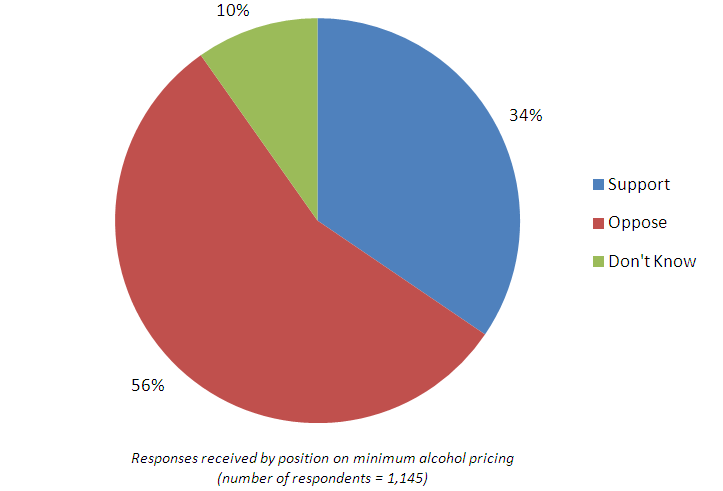
The Home Office received 1,145 answers to the silly question as to whether minimum pricing is a good idea, and the majority again rejected a nanny state initiative by a comfortable margin.


And if you thought 56% against and only 34% in favour was a good result, wait till you see the pie once business organisations, NGOs and other assorted vested interests were stripped out.

Responses from ordinary members of the public - such as we jewel robbers, for example - opposed minimum pricing by a factor of three to one! 


Now that's what I call a real thrashing!

Perhaps Labour should re-consider nailing their colours to this wrecked mast, for two reasons. Firstly, it is indisputable that the policy would have harmed those with less money - that's what regressive laws do, and Labour so hate regressive laws, don't they - and, secondly, just look at those numbers! 

Are they really prepared to go to the country advocating a Soviet style price fixing policy which three quarters of the public oppose? 

Good luck with that whole biting voters' hands thang, comrades, but today should really be the last we see of the abomination. 


Friday, 12 July 2013

Fantastic Friday!

There are two campaigns in the sidebar to the right, who would have ever predicted they'd both be announced as successful on the same day?

In the morning plain packs was officially - and quite rightly - shelved, and while nanny statists were still whining like a 747 approaching Heathrow, minimum alcohol pricing was ditched in the afternoon. Cue the most hilarious hyperbole, gnashing of teeth, tearing of hair, and weapons grade shroud-waving ever seen from bansturbators ... and that's saying something considering they're ridiculously over the top on a quiet news day!

The BBC, of course, did its best to pretend this was the government equivalent of a football referee missing the ball blatantly bouncing over the goal line, but it's been very clear from news comments sections, Twitter feeds and Facebook discussions that both these policies were not popular, were ridiculed by the public and were making politicians look even more stupid than they were viewed beforehand.

Of course, there were the usual nonsensical claims of double-headed industry execs with red horns mesmerising the government as they liberally tossed millions of £50 notes at lobbyists, but - like tantrum-throwing children - flinging insults and blaming just about everything and everyone for their misfortune is what the public health industry have always done. So no surprise there.

Jeremy Hunt threw a bone to the pack of slavering, threat-laden public health mongrels on plain packaging by quoting a selective stat
“Of those who provided detailed feedback, some 53 percent were in favor of standardized packaging while 43 percent thought the government should do nothing about tobacco packaging,” Health Secretary Jeremy Hunt said in a written statement to Parliament in London today. 
Surprising that he should pick that one when the real story of the day was how roundly the plain packs policy was rejected. You see, the figure Hunt provided to parliament was restricted to those who took time to formally write in and answer the 15 questions the consultation asked. Just 2424 of them (see page 14 here). As you can imagine, a significant proportion of those will be state-funded bodies or individuals whose job it is to submit such stuff.

A more significant conclusion to take from that soundbite is that over 1,000 ordinary people were motivated enough about the subject to go through the purposely onerous rigmarole of finding the consultation buried at the DoH website, and ploughing through it to formally register objection, many of whom - I am incredibly proud to say - fellow jewel robbers who forwarded their efforts my way by e-mail (I still have a folder full of 'em).

But that wasn't the whole story by any means. There were 665,989 responses in total (page 31) and this is how the overall picture looks. 


No amount of blaming Lynton Crosby or tobacco companies for putting pressure on politicians can hide the undeniable fact that the public - you know, those people a democracy is supposed to listen to - are behind this correct decision by a factor of two to one. It's that simple.

The tobacco control industry should take some of the same medicine they've been spooning out for years ... get over it, move on, the public have spoken.

In the meantime, it's Friday, the sun is out, and the health Nazis have received a well deserved smack in the chops. Crack open a bottle of your fave tipple, spark up a cigar and party like it's Friday 12th July! 


Thursday, 21 February 2013

Another Blow For Minimum Pricing - Alcohol 'Availability Theory' Debunked

This study, published last week, is very interesting. Investigating the effects of the Licensing Act 2003 - you know, the one where '24 hour drinking' was set to plunge Britain into a drunken version of Mad Max according to the more excitable press - the authors investigated Manchester Police records to see if the many popular myths about its link with drink-fuelled violence had any basis in fact (emphasis mine, it crops up later).
We treated the removal of trading hour restrictions that resulted from the Act as a natural experiment in order to test two competing hypotheses: first, that flexible trading hours would lead to a reduction in levels of violence (as predicted by the Labour Government); and secondly, that flexible trading hours would increase levels of violence (as predicted by availability theory [8]).
Study and micro-study Manchester Police statistics as they might (the lead author was from Cambridge's Institute of Public Health) they just couldn't find any increase in violence attributable to so-called "24 hour" sales under the Licensing Act 2003.
This study found no evidence that a national policy increasing the physical availability of alcohol affected the overall volume of violence.
In case you suffer one of those Daily Mail believing relatives (as I do) who attribute town centre Armageddon to Blair's loosening of licensing restrictions, try showing them this (click to enlarge).

Violence (a), robbery (b) and total crime (c)  against weeks after legislation (2004-2008)
There is nothing in those graphs to justify moral panicking from certain sections of the media. In fact, some might claim a decline at the end there, doncha think?

Which kinda agrees with something I posted up in December 2010 following a FOI request.
So, although consumption is most definitely decreasing, the behaviour of those out on the razzle must be appalling. After all, there wouldn't be the great call for minimum alcohol pricing to stop all those youths 'pre-loading' otherwise, right? 
To find out, it's best to ask the experts. And this is where the Freedom of Information Act can be so very useful. For example, if you asked a large police force - the Metropolitan Police is a good one - how many people have been arrested for 'drunk and disorderly' since 2001, what do you think the response would be?


Not altogether dissimilar, I think you'll agree.

This puts another spoke into Cameron's justification for minimum alcohol pricing. Remember that it is being pitched as tackling binge-drinking and public order on the 'evidence' of low priced availability - because they haven't a cat in hell's chance of getting it past the EU on health grounds, of course.

But according to the above study, availability of alcohol is pretty inconsequential. If you're planning to get shit-faced and cause trouble, you're going to get shit-faced and cause trouble. If you're not intending to, you won't.

Widening the hours that alcohol is available didn't change that, nor will the addition of a couple of quid on a bottle of cheap vodka. People generally know what they want from life and have always been more resourceful than politicians take them for. To think that the public will suddenly behave to match what a shonky computer model - created by inept researchers from Sheffield University - says they will, is absurd.

That seems to have put paid to this 'availability theory', then. And so it should, because the reference points us in the direction of this from 2004.

Oh look, the world's authority on 'availability theory' is apparently our old friend Tim "Cyclops" Stockwell, the same clown who accepts evidence he agrees with and discards anything he doesn't, and is responsible for conning the BBC into publishing demonstrable garbage about, you guessed it, minimum alcohol pricing.

The forensic search for any credible real life benefit to minimum pricing continues, then.


Thursday, 7 February 2013

Minimum Alcohol Pricing Folly: Goodbye Clubcard And Nectar Points

The more one looks into the implications of minimum alcohol pricing - and I've only just started - the more of a sinister minefield it turns out to be.

By minefield, I mean a legislative nightmare as well as unnecessary costs to small businesses (odd that; aren't Tories supposed to like them?). For example, signage will be required; stock may have to be removed from sale and renegotiated on price with suppliers (more on that another time); and many products will cease to be profitable, not only for the retailer, but for the producer too. This will inevitably lead to an increase in your shopping bill somewhere along the line, whether booze is bought or not.

Current advice from retail bodies is to err on the side of caution or face crippling fines. And that's where you come in because, if you buy drink responsibly, you will still lose out.

When you go to Tesco, Sainsbo, whatever, do you get loyalty card points on tobacco? No, course not, it's bad for you, right, so it's banned. Well, hey presto! With minimum alcohol pricing, this is exactly the result that is likely to happen for alcohol too.

Firstly, if you buy a minimum alcohol priced bottle of wine for around £4.20, those four Clubcard/Nectar points you earn will represent a subsequent value, however small. If you were then to redeem that value, the saving technically drops the cost of your bottle below the minimum price. It is most certainly the end of vouchers before Valentine's Day offering 50 bonus points if you buy a bottle of Baileys, that's for sure.

There is also the issue of saving vouchers or points up for other special occasions. If, like me, you hoard your rewards for a big blow out at Christmas, you could end up buying - say - £100 worth of alcohol and redeeming vouchers/points for £80, for example. That means you are buying alcohol - any alcohol - well beneath the minimum price.

It's a grey area, but retailer associations are advising that the best course is to not award loyalty bonuses to purchases of alcohol at all. Why devise an complicated system to get round the problem when it is easier just to exclude alcohol entirely, eh?

Tesco, of course, are 100% behind minimum pricing so will happily deprive you of your Clubcard points. Others will almost be, I dunno, "nudged" into it by people who have been asking for exactly that for a long time.
Dr Brian Keighley, chairman of the BMA in Scotland, said stopping UK supermarkets offering loyalty points would at least send the "right message". 
"Most alcohol bought for consumption is from supermarkets. There is a need to send the right message on drinking behaviour by not allowing 'rewards' for buying alcohol."
Minimum alcohol pricing is touted as tackling irresponsible drinkers but - as a sage website bluntly asks - why should responsible drinkers pay more?

Of course, if the true plan is to move towards a policy of denormalisation of alcohol, it's just dandy.


Tuesday, 5 February 2013

Minimum Alcohol Pricing Folly: What Is Success?

To continue with an occasional series on David Cameron's daft minimum alcohol pricing idea, let's look at what can be considered as 'success' if it were to be implemented.

The Home Office have stated that they are predicting a "just over 3%" reduction in sales if a 45p unit price is adopted. Of course, this is based on shoddy policy-based evidence commissioned from Sheffield University specifically for the government's purposes, but let's ignore that for now.

Here is how alcohol consumption is trending according to statistics on alcohol sold per capita.


From 11.5 litres per head in 2004 to 10.0 litres per head in 2011, consumption is already falling by a thimbleful below 2% every year.

So, say minimum pricing was installed tomorrow and there was a 3% reduction in consumption for the following year, would the Home Office claim that it was a success? I think we know the answer, don't we? Cos they is lying bastards.

But wait! The government has also been trumpeting the success of their responsibility deal, which they announced as having taken one billion alcohol units out of the marketplace. What percentage does that represent? Coalition MP Norman Lamb has helpfully provided us with the answer.
"One of the consequences of the responsibility deal is that by 2015, 1 billion units of alcohol - about 2% - will be taken out of the market, and that will help some problem drinkers significantly."
That's, presumably, an extra 2% on top of the ongoing 2% trend, yes?

But then, as we are constantly told, there is this 'epidemic' of drunkenness which for some strange reason isn't borne out by official statistics. Perhaps there is an imminent increase in wild, crazy alcohol consumption to come.

Well no, apparently not. You see, the independent Office for Budget Responsibility (OBR) has predicted that consumption will continue to diminish right through to 2018 [opens in Excel, table 2.11]  An 'epidemic' that has been declining for best part of a decade and is predicted to carry on spiralling downwards for another five years is not particularly scary, I'd venture.

Still, let's crunch the figures anyway.

My little iPhone calculator here says that - based on average strengths of beer, wine and spirits - we're talking another reduction in consumption of about 2.4 billion units by five years time. If one billion is 2%, that's another 4.8% or a percentage point per year, give or take.

Therefore, to achieve the fabled 3% reduction solely through minimum alcohol pricing, there would have to be a reduction in consumption in excess of 8% - or thereabouts - in the year after it is made law if minimum pricing is to be hailed as a success.

No, of course it won't happen. The current decline - which has been evident for at least seven years now - will be held up as proof positive that minimum alcohol pricing has worked. The minority who favour it (mostly public-funded health lobbyists) may even throw in a heart attack miracle or two as well, they like that kind of junk stat.

We've seen it all before, haven't we?

But more importantly, what's the point? If alcohol consumption is already falling; if it is predicted to carry on falling by the OBR; and if the responsibility deal is working as intended (despite alarmists saying it wouldn't, by the way), why the need for a deeply divisive policy whose design will undoubtedly take money from the less well off and give it to the not-so less well off?

It does beg the question, doesn't it? Is this a class thing?